
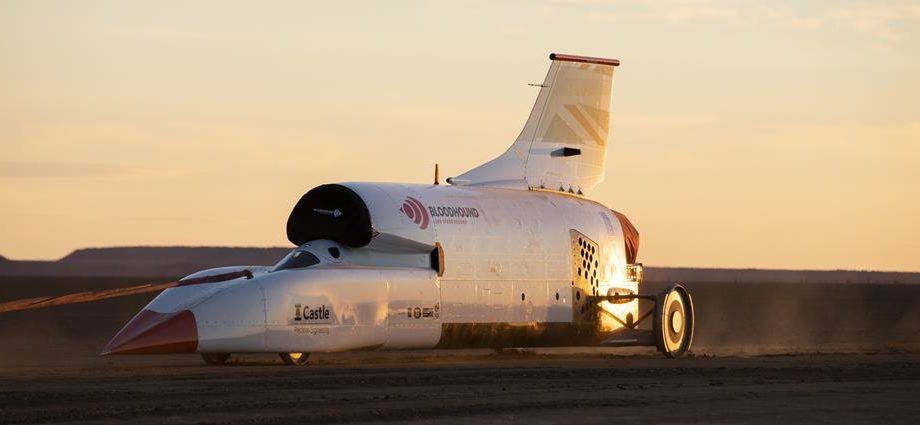
The Bloodhound LSR team’s attempt to break the World Land Speed Record is hotting up, with the beginning of high-speed testing in South Africa. Calibre talks to the man behind the wheel, Wing Commander Andy Green.
Whatever the Right Stuff is, it’s clear that Andy Green has it in abundance. He’s an Oxford mathematics graduate who went on to become a fighter pilot, a Wing Commander in the Royal Air Force and a multiple-world record holder. For a time, he also captained the RAF’s Cresta Run team, and now he’s aiming to break his own World Land Speed Record as part of the Bloodhound LSR effort .
.
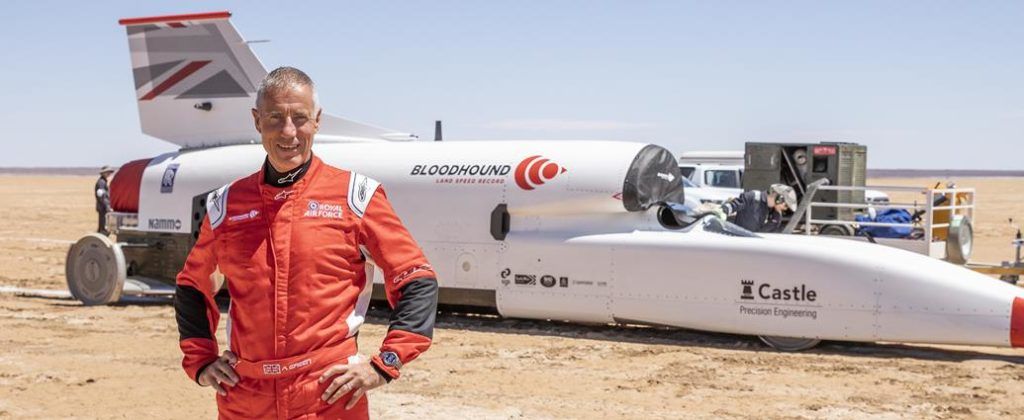
At 57, Green still cuts an athletic figure. His piercing blue eyes and imposing stature complete the comic book hero effect, almost as if he was born to assume the role. But the reality is that he’s got here through sheer hard work. State-educated, he secured his place at Oxford thanks to an RAF scholarship.
His resulting career as a fighter pilot – in Phantoms, Tornados and Harriers – helped him to land the job of driving Bloodhound’s predecessor, Thrust SSC. Back then, he was pitched against 15 other candidates in a lengthy selection process run by the Centre for Human Sciences in Farnborough. The question of whether or not to open the job up to other applicants for Bloodhound was apparently discussed, but the team concluded that they already had someone uniquely qualified for the role.
“Flying fighter jets for 20 years is the best preparation I could possibly imagine for something like this,” he comments. “I haven’t flown jets for a while, but I’ve still got all the training that went into that and I still fly high-performance aeroplanes on a regular basis – they may not be as fast, but they roll faster, they pull more G and, actually, in some respects, they’re harder work.”
He currently owns a share in an Extra 300 – a highly aerobatic single-engined stunt plane that’s capable of pulling ±10G. That’s far more than he should ever see in the Bloodhound cockpit, where the acceleration will peak at just over 2G while accelerating and around 3G while braking. In fact, travelling from nought to 1,000 mph in one minute, as the team eventually hopes to do, equates to an average acceleration of 0.8G – less than the force that’s pushing you into the ground right now.
That’s not to say that driving at supersonic speeds isn’t physically challenging. Aside from reacting to crosswinds and surface changes that could throw the car off course, there are also a number of physiological effects to deal with. For instance, the sudden reversal in acceleration when the car starts to slow down can trigger what’s known as a somatogravic illusion, causing it to feel like the car is pitching violently downwards. After a while, the rush of blood towards your feet can also bring on tunnel vision and greying out. These effects are rarely encountered by racing drivers, who face comparable forces to those found on Bloodhound, but for much shorter durations. The only people who deal with them on a regular basis are fast jet crews.
On top of the physical demands, there’s also the mental acuity required to analyse the car’s behaviour and spot any anomalies. That’s where Green’s background as a mathematician comes in, helping him to understand how the car should respond to inputs.
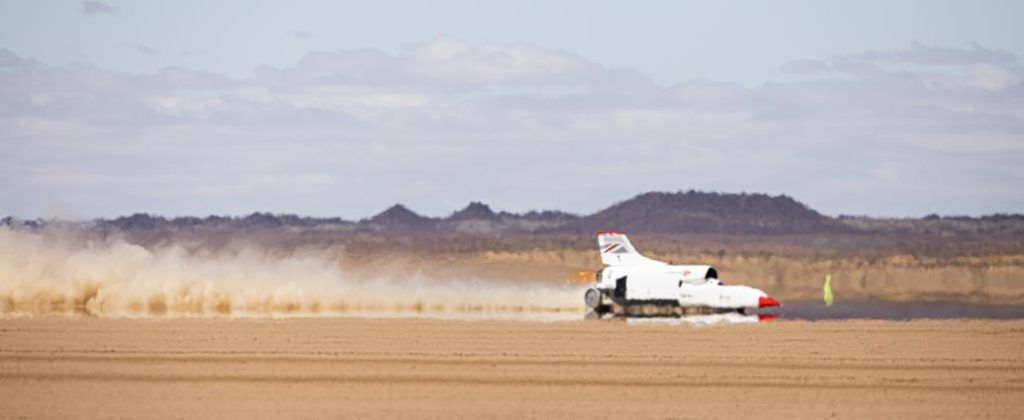
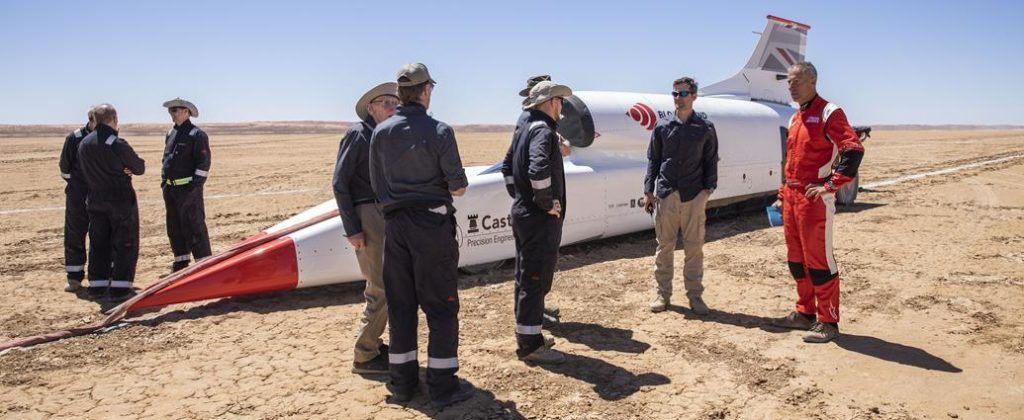
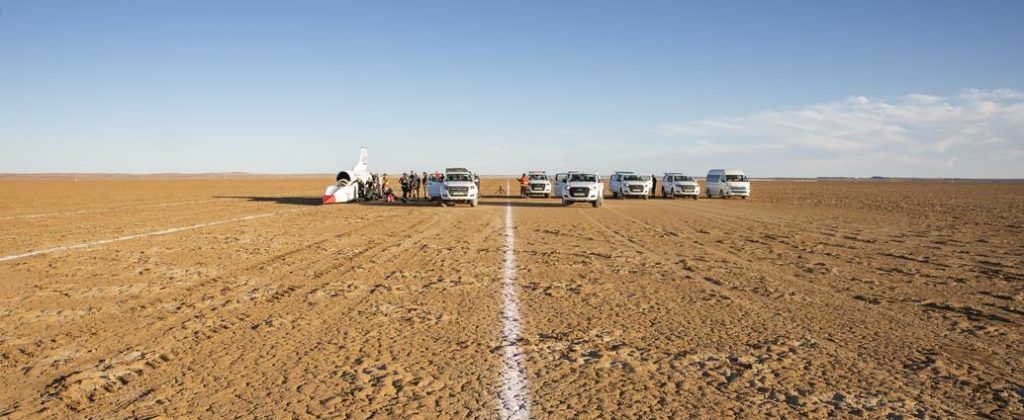
It’s a process that’s already coming in handy as the team begins its first phase of high-speed testing, edging up to 500 mph in increments of 50 mph or so – analysing copious quantities of data at each stage to ensure it’s safe to proceed. For this first batch of runs, Green and his colleagues aren’t even using the 80,000 hp rocket motor that will eventually supplement Bloodhound’s jet engine. Next year they plan to return with the rebuilt car to set a new World Land Speed Record. Exactly how fast the car might go remains to be seen, but it’s been suggested that it could crack 1,000 mph. That’s faster than a jet fighter at low level.
“The numbers on Bloodhound are astonishing,” comments Green. “Even simple things like how fast the wheels rotate. Every single scientist or engineer you speak to will find their own wow factor in the car’s specification. I did a presentation a few years ago, and one of the other speakers was Dr Brian Cox. Afterwards, he came up to me and said ‘did you really say the tips of the wheels experience 50,000G?’.”
Such marvels are everywhere in this project: the rocket exhaust nozzle is designed to run at twice the temperature of molten lava; the car will cover a kilometre every 2.2 seconds at top speed, and just two minutes after it sets off, Bloodhound could be stationary again some 12 miles away from its starting point.
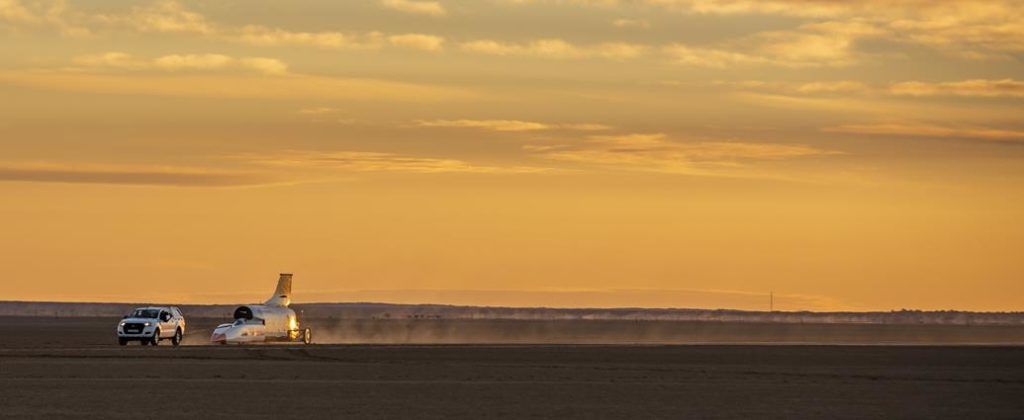
At least, that’s the plan. For all the technical genius behind Bloodhound, the sheer resources involved have proved problematic at times. Now, under the management of new owner Ian Warhurst, the car is taking part in its first high-speed desert runs. These will generate invaluable data that will allow the team to optimise the car for a proper record attempt next year.
When that happens, it will mark the culmination of more than a decade’s work from a large team of highly talented engineers, aided by access to military-spec hardware and the only person on the planet to have first-hand experience of driving a supersonic car. Such is the scale of the project that, if it succeeds, the new record may never be broken. That would truly make it a landmark human achievement and the ultimate accolade for The Fastest Man on Earth.

- Driven: Princess S78 Luxury Yacht Review - 28 January 2021
- The Fastest Man on Earth - 8 July 2020
- Driving Senna’s Supercar: The Honda NSX - 31 August 2019