

Highway Thru Hell, the Canadian TV documentary about heavy rescue operators working on the roads of British Columbia, initially showcased Jamie Davis and his fleet of brightly polished, chrome-heavy trucks. Obviously a man with a firm view on how he wanted his brand to look, the fleet culminated with the purchase of a $739,000 Rotator, a swivelling crane with a lifting capacity of 75 tons. And yet, for all his flamboyance, Jamie’s thunder started being stolen, series by series, clip by clip, by Al Quiring and Gord Boyd of Quiring Towing.
Where Jamie’s trucks are red, Al’s are green. Where Jamie is all about the spit ‘n’ polish, Al is more working patina. And where Jamie seems to love the limelight, Al is happy to just quietly get on with recovering trucks, throwing in the odd wisecrack along the way. They might have gone to school together, but they’re poles apart in just about everything else.
Everything, that is, except the careers they chose because they share a love of recovering heavy trucks from one of the most dangerous stretches of road in North America, the Coquihalla Highway.

Highway Thru Hell: The Coquihalla Highway
Work started on the 303km, four-lane highway in 1987 and was finally completed in 1990. The original budget of $250m was blown when they overspent by two-thirds, but then the challenges the engineers faced were almost unique. There are 38 overpasses and a number of avalanche control areas. Fences, gates, underpasses and one overpass allow wildlife to migrate across the road.
The Coquihalla Highway, also known simply as The Coq or the more utilitarian Highway 5, reaches out from Vancouver into the Canadian interior, linking the southern Trans-Canada route (Highway 1) with the northern Trans-Canada/Yellowhead route (Highway 16), and is the most direct route to both Edmonton and Calgary.
And The Coq is where warm, moist air from Hawaii meets cold, dense air from Alaska. As much as a metre of snow can fall on the road in a night, and it arrives as wet, dense snow rather than the fine powdery version loved by ski enthusiasts. It packs down tight and firm and gives little traction, especially when it freezes. The snowbanks lining the road can reach four metres in height, so there’s nowhere to go if a problem unfolds in front of you while you’re driving.
The Coq is also used by visitors and industrial traffic, amateurs and professionals, and when there’s a problem, the effects ripple out for mile after mile.

Highway Thru Hell: Meeting Al and Gord
I meet up with Al on a sunny Monday in early June. It’s clear and bright. The phones aren’t ringing, and the loudest noise is a gentle hum from the road outside. The yard is quiet and unassuming, like the man himself. There are no signs to show what lies behind the wooden fence, but my sat-nav tells me when to turn, and when I do, I see that famous green wrecker, which is, I find out, a 2007 Kenworth T800 Tri-Drive equipped with a P850 side puller and Vulcan V100 wrecker unit.
Alongside it is Gord’s matching truck. With ‘Plan B’ emblazoned across the bullbar (“by the time I arrive, Plan A has already failed,” Gord quips), it’s a $600,000 show of faith in Al’s righthand man; where most employees are given a truck off the fleet to drive, Gord was allowed to spec his own truck — and only he is allowed to drive it.
Over coffee and doughnuts in the office, the pair are open about life after Highway Thru Hell, their relationship with the rest of the stars, and the way that life on The Coq has affected them.

Highway Thru Hell: Hell’s Highway
The show has been good to them, they say. They enjoy the opportunity to show off their skills and showcase their profession to a wider audience. While they’re conscious that any mistakes they make (“And it does go wrong,” admits Al) will be amplified via the internet, it’s a risk they’re willing to take. They’re as confident of their skills as men with decades of experience in the field are allowed to be; unconscious competence at its very best.
They’re confident but not cocky. Gord is fond of saying that it’s all about physics, mainly Newton’s Laws (specifically the third) and Archimedes’ Law of the Lever. With a decent understanding of them, Gord claims that the job they do is simple. With some pushing, he admits that experience helps. Pushed still further, he admits that a big pair of balls comes in handy, too.
I’d add stamina to that. The guys sometimes work for days at a time when they’re out on The Coq; if there are people to be rescued, then they can’t knock off until everyone is shiny side up again and on their way. Both men carry several changes of clothing in the lorry, spare boots, and even meals, which they heat in little 12V ovens. Both men are advocates of decent coffee, too, and Al’s wife’s mac ‘n’ cheese gets a mention as being “the best in the world”.
Logistics: Gord tells me that he buys his work gloves by the dozen, throwing wet ones on the floor of his cab to let the heater dry them. Al goes on to tell me that the highway engineers have discovered that sugar beet juice not only de-ices roads better than salt and calcium chloride, but it also does so down to -15ºC, a full 10 degrees lower than salt. It is also less of an environmental problem when it runs down into the Coquihalla River. But for Al, the advantage it offers is more personal: “I used to pull my gloves off after working out there, and my hands were so sore and cracked [from the salt] that I was in agony.”
But while beet juice might keep the boys’ hands in good shape, this is still a brutal industry. Temperatures of -30ºC are commonplace, as are howling winds, snowstorms, and heavy rain squalls that instantly freeze, leaving ice that has been, on one occasion, four inches thick. “The controllers were looking at the TV monitors back at HQ and said to us that the road looks fine and would be reopened. ‘Hell, we can see the white lines,’ they told us. We told them that we were playing ice hockey out there!” Al laughs.
And, while the aim is to keep the Coquihalla Highway open at almost any cost, sometimes it’s just too damned dangerous to do so. When it’s backed up with cars and lorries that have slid to a halt, the road is shut and Al and Gord get to work pulling them up the hill.
Pulling them up The Smasher, mainly. I drove along The Coq the day before I met up with them, and, coming from the north, I have to admit that I couldn’t see what the fuss was about. By then, I’d been in Canada for a month, meandering across roads with names like The Top of the World Highway, the Alaska Highway, and even the modestly named but deceptively dangerous Dempster Highway. Sure, The Coq was a bit windy, steep in places, and with some nasty drop-offs, but it didn’t look that bad.
And then I hit The Smasher. Passing under the 300m snow tunnel, I started down what ended up being a 28km-long constant drop. It’s relentless — and remorseless. While there are run-off areas that allow drivers to stop runaway trucks safely, some don’t see them, while others don’t bother using them: Al reckons that about one in 20 lorry drivers doesn’t pull into the brake check area. Others don’t know how to use their engine brakes or leave their trucks in the wrong gear, so they end up riding their brake pedal the whole way down.
“They then hit the bottom with red-hot brakes, smell something funny, and pull over. The brakes then get even hotter because there’s no air rushing over them to cool them — and they burst into flames. Next thing you know, you’ve got a truck on fire.” Al smiles, but it’s a forlorn smile that is half acknowledging the funny side but is simultaneously bewildered that anyone would do a job they didn’t understand, one they hadn’t mastered. Especially on The Coq.
This is a constant theme: whether it is drivers racing through a snowstorm at 120km/h or truck drivers with no snow chains (or the wrong ones, or no idea how to use them) the problems the men describe seem avoidable, in the main.
Al tells me that he has been pushing for a safety sticker to be issued. The idea is simple: drivers are pulled over by highway officials and asked to demonstrate that they have snow chains and, crucially, know how to put them on. Those who pass are given a sticker to put in their windscreen to show they have the equipment and skills to drive along The Coq in bad weather.
It’s a simple idea. And possibly a life-saving one.
Highway Thru Hell: Tools of the Trade
Al wanders off to find his mobile phone, leaving Gord and me alone for a while. You, like me, have probably enjoyed watching Gord lose his temper on Highway Thru Hell. Clearly a man with little time for those who can’t do their job to a reasonable degree of proficiency, his forthright advice to drivers to “straighten the fucking wheels” has had me howling with laughter.
In person, Gord is still a slightly larger-than-life character but much warmer, friendlier and, well, nicer than I was expecting. He is an alpha male without being macho; his is the charisma that boardroom executives and city gym rats aspire to, but rarely achieve. He knows he has nothing to prove anymore, so he doesn’t bother thinking about it, much less worrying about how he comes across.
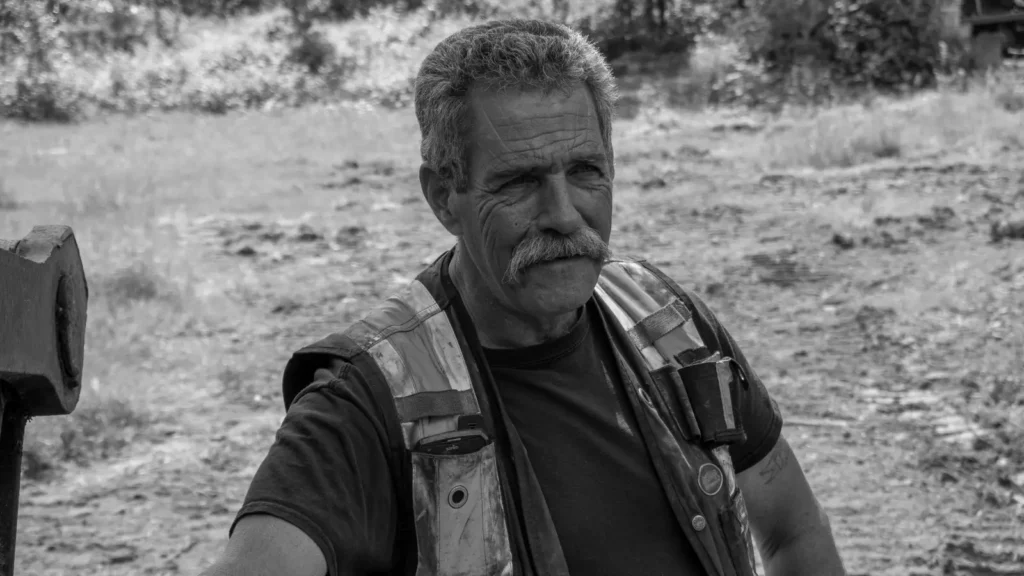
The creases on his face tell of a life lived outdoors — and one with plenty of laughter. He smokes and tells me more about the job, and about working for Al. He clearly loves his work (“Hell, if I didn’t do this, I’d have to get a real job!”) and Al, too; he tells me he’s treated as one of the family and feels utter loyalty in return.
Not that Gord is a pushover. It’s just that he and Al have been working together so long that any wrinkles have been ironed out long ago. Alpha males don’t fight, because they’ve each got their own territory, their own skills, their own life; it’s only insecure men that throw their weight around, bicker and score points. Real men just get on with the damned job and don’t get in each other’s way.
He tells the story of a job where he was the last member of the crew to arrive. The other guys had already rigged the stricken truck as far as they could and left just enough space for him to pull his wrecker in. The others knew where his strengths lay, and where he’d need to place his truck to make the most efficient use of it. I imagine that sort of thing happens a lot.
The filming crew are really good, he says. Tight and well-organised. In the main. He tells me that he abandoned one cameraman twice in one night, leaving him alone on the side of The Coq when he was too slow to get back into the truck: “The customers are my priority. I’ll make allowances for the film crew, but when I’m ready to move, I’m gone. If they don’t get back in the cab when I tell ‘em, then I’ll leave ‘em behind.”
He softens the story by going on to say that he made it up to the tardy cameraman by pulling an enormous drift in Plan B in a deserted, snow-covered parking lot. “I told him to stand there and get the camera rolling. I then locked everything up and pulled the biggest drift you’ve ever seen!” he laughs.
He shows me around Plan B with pride. He says that he prefers manual gearboxes to automatics because then he’s in control. He says he uses the clutch to pull away and then doesn’t touch it again, negotiating his way through the truck’s 18 gears using mechanical sympathy and a deft touch alone. Power-shifting his way up the ‘box is his party trick; those snatched tows you sometimes see him giving? They’re deliberate, not accidental. Certainly not poor form, or anything close. That’s Gord letting the driver know that he’s mightily pissed off because the other guy hadn’t brought his A-game to the situation, that he’s been stupid enough to come to The Coq with nothing but the vaguest idea of what he was doing — and almost none of the equipment with which to do it.
But, worst of all, that guy hadn’t shown humility. He’d fucked up and didn’t even have the decency or grace to listen to what Gord was telling him. I’ve seen both Al and Gord coach other, less experienced recovery operators through a difficult recovery. They’ve also helped and towed motorists and not charged them a penny. Quiring Towing is intimately involved with the community where they live and work — and has been for four generations. They know the value of being good neighbours, whether in their local town or The Coq.
These are not men who are in it for the money. And when some asshole expects to have his problems solved with no input whatsoever, bar handing over a credit card? No fucking way. You are involved, son, you can hear Gord thinking. You’re invested and committed; you’re going to stay involved, even if all that means is steering your rig in the right direction and helping out a little when your driving wheels get traction again.
Gord’s tools are as neatly sorted as you might expect: “It’s hard to keep tools neatly organised in a moving truck,” he explains, but they look pretty well organised to me. They’re sensibly grouped, clean, and some sport a protective coating of clean grease. Gord is obviously a man who takes as much pride in his tools as he does in his driving.
His recovery chains hang in knot-free lengths. His shackles are easily accessible, as are his snatch blocks. Used to change the direction of a pull, these can also be used to increase the pull the truck’s winch can exert: adding one snatch block halves the speed of the pull, but it doubles the power. Another doubles that. And so on, almost ad infinitum, like Swift’s fleas.
Towing hooks, blocks, bolt croppers, hydraulic connections, wiring harnesses, and a locker full of nothing but hammers (Gord is a keen advocate of the principle of percussive maintenance). The list goes on, but my head is spinning.

Highway Thru Hell: Mechanical Sympathy
Al returns. Taller than me — which isn’t something I get to write very often — he asks me if I’d like to see his Caterpillars. We wander around the back of the yard where two Caterpillar D9s sit. The D9 is the workhorse of the construction and mining industry: if the Land Rover helped conquer the world, and the JCB helped build it, the D9 flattened it.
Weighing almost 49 tonnes, the D9 remained in production from 1954 all the way through to 1987, albeit with some revisions over the years. Powered by the D353 diesel engine, most were fitted with shovel blades at the front and ripping plough-type blades at the rear. Al has no use for a ripping blade, so his D9s have hydraulic winches on them. As you’d expect.
He scrambles up into the cockpit and fires one straight up. Al might enjoy tinkering with them and restoring them, but they’re working tools and need to start on the button, every time. He tells me how he came by each one, what work he needed to do to get them running and operating again — and then he tells me how much one can earn for him in a day, and I’m impressed.
Gord extols their virtues, too; both men are obsessed with winching heavy stuff, which is exactly how I hoped they’d be. While the advice to never meet your heroes is a sound strategy, Al and Gord are the same straightforward, plain-speaking men I’d watched on the television.
Gord rides a Harley-Davidson and drives an old step-side pickup. Al drives a modern Dodge Challenger, you know, the one with the supercharged V8 engine. Both wear Carhartt work clothing and sport moustaches, and neither seems to sweat the whole shaving gig too much. Gord professes a penchant for moose steaks and Scottish whisky, and both swear freely. Not the casual ‘the fucking fucker’s fucked’ profanity of the ill-educated, but the insertion of carefully modulated swear words that add emphasis and tonality.
Al is sitting on an old wheel now, shaded from the fierce midday heat. And so, even though I have known him for only a couple of hours, when he looks up at me and uses an expletive to describe how bad an accident was, I know that it must have been really bad.
Highway Thru Hell: Bottling It Up
Soldiers, police officers, and roadside rescue crews are among those forced to face sudden, violent and messy death with something close to equanimity. They have no time to sit and weep at the roadside for any loss they bear witness to; they’ve work to do, and so they get on with it with professionalism — and the odd touch of black humour.
(Black humour doesn’t travel well, so I’ll leave it there; if you’ve done the job, you’ll know that it’s a defence mechanism, a coping strategy, and absolutely not designed to be disrespectful of the dead or dying.)
And yet, while both men are the very definition, both physically and mentally, of what it means to be a man in today’s often contradictory world, neither is shy of admitting to crying on occasion. Al tells a harrowing story about a road crash he happened upon locally. He says that one particular smell makes him cry, even now. Gord tells of dealing with an incident before going home and hitting the whiskey bottle. Hard. Their stories are told, and I tell a few of my own. Sharing like this helps a little. It bleeds off a little pressure and turns down the saturation level a bit.
They are open about the effect the job has had on them, yet neither has accepted counselling, despite both having been offered it. Gord says he fears what would happen to the counsellor if he unburdened himself.
The truth is, I suspect, that they, like so many others, prefer to keep it bottled up, where it can only seep out a little at a time at moments like this. Talking about it openly and honestly might engender a Champagne-style eruption of cork — and who knows where that would end?

Highway Thru Hell: Cleaning Up
Speaking of which, the trick to freeing The Coq of stranded motorists is to free it from the start of the obstruction rather than the end. This is why you’ll see the chaps reversing at 30km/h in the overtaking lane to get down to the bottom of the hill as quickly as they can; were they to turn around and drive down the right side of the carriageway, they’d simply be left at the bottom behind all the cars that are stuck.
So, they reverse down as quickly as they safely can and do so in the outside lane because they can then use the crash barrier as a fixed point upon which to orient themselves. In a snowstorm, it is easy to get disoriented, and using the guard rail to align themselves keeps them on track and away from the edge of the road where snowbanks form and within which stranded cars have been known to lurk.
Other debris is a problem, too. Inferior tyre chains snap and shed their links and lengths across the road. The snowplough pushes them to the side, where they lurk, waiting to chew through the snow blower’s simple but surprisingly fragile mechanism. When this happens, it can be months before a replacement part arrives, generally from abroad.
Cars overtake snow ploughs on the right, too. In doing so, they drive straight into the path of snow being pushed aside — and often straight into the snow plough’s blade. The outcome isn’t a positive one for either party, and it usually means that the snowplough has to come off the road for a while, further straining already stretched resources.
Drivers use their cruise control without thinking, setting it in the valley at Hope and then leaving it engaged all the way to the top of The Coq, where rain falls as snow and wet roads are frozen. They hit sheet ice at 75mph, and the problem has ended before they’ve had time to react.
But these problems are Quiring Towing’s bread and butter; if people didn’t do stupid things, then there’d be hardly any mess to clean up. The trouble is, cleaning up all that metal often means sponging off and sweeping up bits of people, too.

Highway Thru Hell: Lucky People
Like all good parties, this one has to end. Al has to visit a friend that afternoon, a widow formerly married to another heavy rescue operator who would frequently leave family birthdays, holiday meals, and the like to help him out on bigger jobs. He tells me that he wants to say to her that he’s sorry, that he wishes he could give her back all that time with her husband that she missed. He looks down again, scuffs his boots in the dust, and stands up.
He heads into the office and gives me a Quiring Towing t-shirt. I hand over my business card and tell him that if he’s ever in Britain, to give me a call. He says that he’d love to visit the Dorset Steam Show. I tell him that he’d enjoy it.
I thank them both, and they offer to pose for one more photograph. The sun gets in Al’s eyes. At least, I think it was the sun. They glisten, and he walks away, shrugging off my thanks. “We’re happy to share”, he said. “We’re lucky people. The TV show has been good to us. We know that. We’re happy to give something back.”
Gord, clearly more comfortable with the camera, stands with his hands on his hips, thumbs in the pockets of his jeans. He looks like a cowboy. The sort who’d wrestle steers for 12 hours before throwing on some clean clothes, downing some chow, and heading into town to blow off a little steam. It’s a classic alpha male pose, albeit one that has been unconsciously adopted.
He tells me that a female fan visited them a while back. An older lady, physically fragile, they entertained her in the office for a while, and then Gord asked: “What’s the appeal of the show for someone like you?”
He said she smiled, and that the years fell away from her. “It reminds me of a time when there were still plenty of real men in the world,” she exclaimed. Quite.

- Winter Reading: Books for the Wilderness - 25 January 2023
- Kit Review: Mountain Hardwear Super/DS Stretchdown Hooded Down Jacket - 6 January 2020
- Tested: Outwell Dreamboat Mattress - 29 October 2019