

Does it get any better than this? Cruising through the Cotswolds with the crackle of the Aston Martin DB11 Volante’s V8 ricocheting off the dry stone walls and the last of the evening sunshine flooding in through the open roof. It’s close to perfection.
There are a few things about this car that might cause traditionalists to argue with that conclusion, though. For a start, it has no roof. GT cars are expected to do two things: look stunning and drive beautifully. Yet conventional wisdom will tell you that a soft top is bad news in both respects.

From an aesthetic perspective, convertibles are harder to style, because the space required to accommodate the hood is often created by raising the bodywork around the rear of the cockpit. This can lead to a rather hunchbacked appearance, which isn’t ideal when you’re about to rock up at the Casino de Monte Carlo. Worse still, swapping a nice solid roof for a soft top and an electrically operated hood mechanism tends to reduce the car’s structural rigidity and add weight, both of which can be problematic for its handling.
One look at the DB11 Volante should be enough to dispel any fears about the first point. Hood mechanisms aren’t generally the sexiest part of a car, but in this case, it’s worth giving a nod to the Aston Martin engineers who’ve managed to make their design one of the most compact around. The upshot of this is that the Volante looks like it was designed as a convertible from the outset. With the roof up, it pulls off a pretty good impersonation of the stunning DB11 Coupe.

On paper, the dynamics could still be a concern, though. The Volante tips the scales at a not-inconsiderable 110kg more than the V8-engined Coupe. Part of that weight increase is the additional strengthening required to brace the convertible body, and yet torsional rigidity still falls by around 35%.
We’ll come on to what that actually means for the handling in a second, but first, there’s another point to consider. While the DB11 Coupe was initially offered with Aston Martin’s own 5.2-litre V12 – now only available in the hardcore AMR version – the Volante makes do with the 4-litre twin-turbocharged V8 from the standard car. What’s more, it’s essentially the same engine you’ll find in the Mercedes C63 AMG that starts at well under half the DB11 Volante’s £159,900 entry price.
You can probably sense that there’s a ‘but’ coming here, and it’s a big one. First of all, while the 510hp V8 concedes a hefty 98hp to the original DB11 V12 (and 129hp to the current AMR), it actually comes remarkably close to matching them on torque at 675Nm, compared to 700Nm. It’s also a much lighter engine – enough to cancel out the added weight of the soft top if you compare it to the old V12 Coupe. What’s more, the addition of the hood mechanism shifts the centre of gravity back a few per cent, giving the Volante a slight rear bias, which is potentially beneficial for the handling.
Enough physics; let’s get back to the driving. The first thing that strikes you is the sheer brilliance of that engine. In a world where turbocharging is now all but inevitable to sate emissions requirements, the Mercedes V8 is one of the very few engines that still manages to rev and respond like an old-school naturally aspirated unit. Only the prodigious thrust on offer from virtually zero rpm gives away the presence of those two turbochargers.
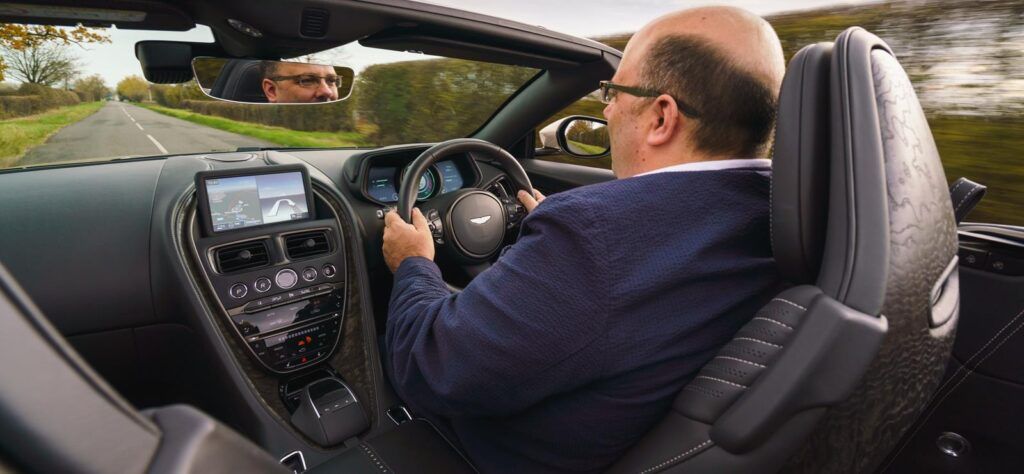
The performance is exhilarating, with the 0 to 62mph sprint dispatched in 4.1 seconds – just a tenth of a second behind the V8 Coupe – and a top speed of 187mph. True, the V8 doesn’t have quite the same symphonic soundtrack as the V12, but it runs it pretty close with a classic V8 growl. The Aston Martin engineers spent a lot of time ensuring that the engine would have its own distinct character, with a harder edge and a more sophisticated timbre than the Mercedes’ muscle car roar.
On a winding road, the DB11 Volante feels remarkably similar to its fixed-head cousins. The steering response has the same precision and alertness – more so than you had in the original V12 coupe – and a lovely balanced feel to the chassis. It rides well, too, with a suppleness that’s missing in many high-performance GTs, and there’s no sign of any chassis flex as a result of removing the roof. What the drop-top configuration does give you is a more visceral edge to the driving experience. It’s an opportunity to experience the wind in your hair and savour that glorious V8 soundtrack.

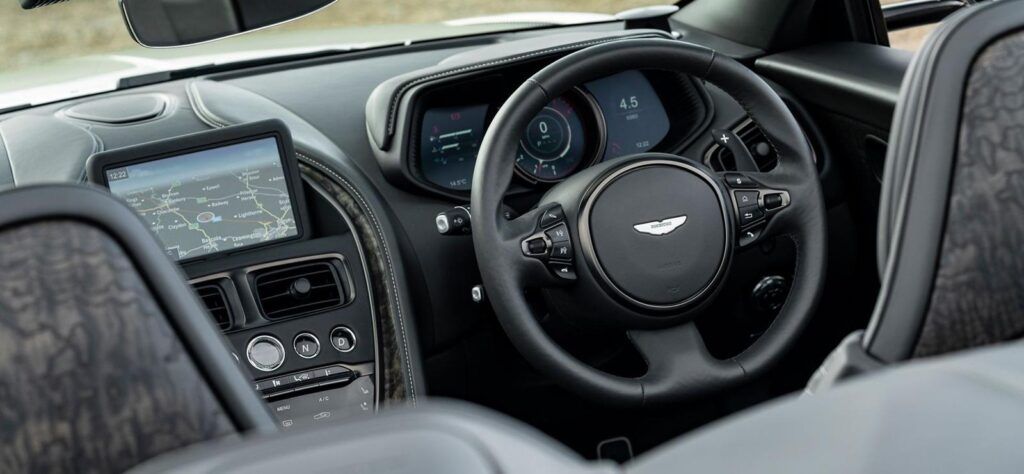
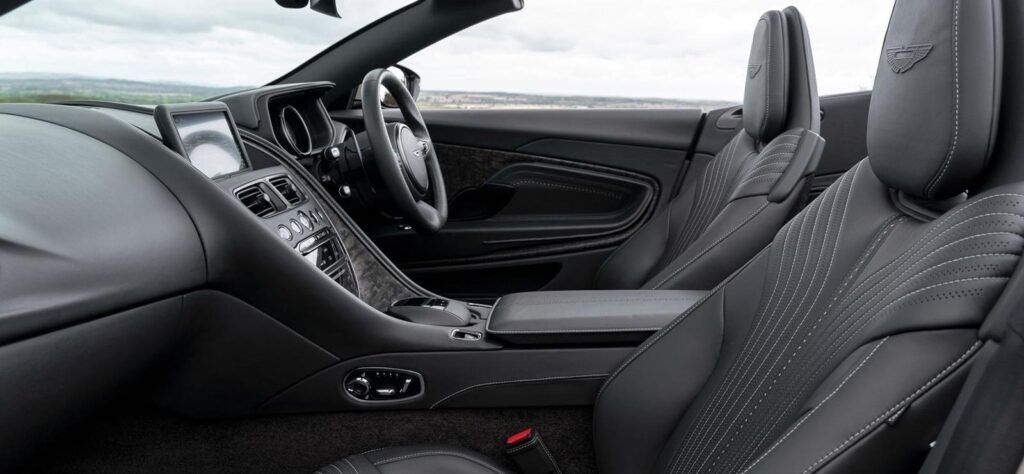
Once you’re done with alfresco motoring, you can raise the eight-layer fabric roof (at speeds of up to 31mph), and then the refinement levels are more or less on a par with those in the fixed-head version. You’ve also got the same beautifully appointed cabin, the same 2+2 seating layout and a reasonably useful boot volume (albeit somewhat reduced from the coupe at 206 litres).
And therein lies the beauty of the Aston Martin DB11. There are more luxurious grand tourers out there, and there are more extreme sports cars, but nothing else strikes quite the same balance between the two. The convertible roof adds an extra dimension to the Volante’s driving experience, making it the pick of the DB11 range and one of the most complete GT cars on sale.

- Driven: Princess S78 Luxury Yacht Review - 28 January 2021
- The Fastest Man on Earth - 8 July 2020
- Driving Senna’s Supercar: The Honda NSX - 31 August 2019