

Kia has dubbed the Stinger (its first foray into rear-wheel-drive) a Grand Tourer rather than a sports car. Whatever its classification, to my eyes, it’s the best-looking car Kia has ever produced, says Ian Angus. It’s also been around for a couple of years now, which is long enough for it to have proved its worth by retaining a decent secondhand price rather than depreciating too dramatically.
So, with this in mind, does it deserve its £40k price tag — and is it worth considering over some of Kia’s well-established rivals?
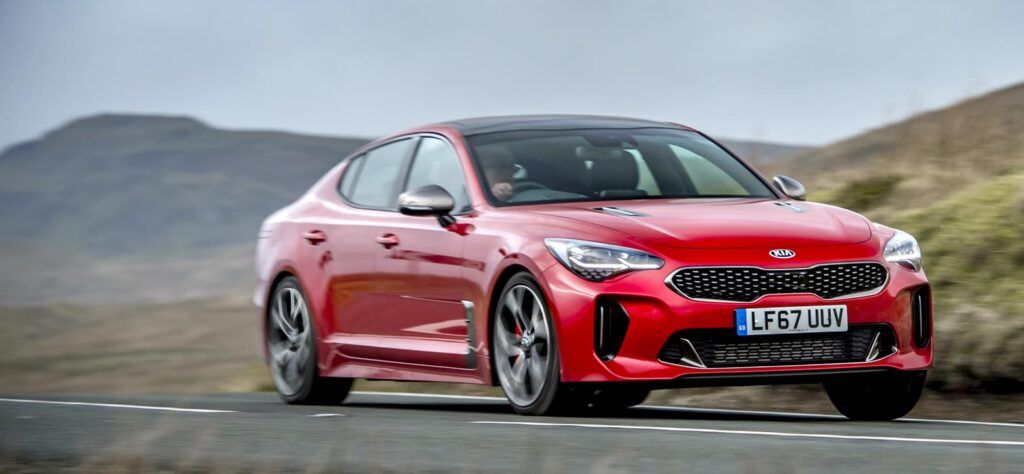
If you’d usually go for an Audi, BMW or Jaguar, the Stinger is firmly in the category of ‘other cars you might consider.’ While it might have all the right elements, it lacks the badge. There’s no getting away from it; Kia is not one of the iconic powerhouses with a rich history behind it.
However, not paying extra for the badge means the Stinger does represent good value for money. If you opt for the range-topping 3.3-litre, twin-turbo V6 petrol-engined version, then you need very few optional extras; the only additional costs I could see on my press car were the floor mats (at £65) and the impressive red paint job at £665. The 19-inch alloy wheels, Brembo sports brakes, Nappa leather upholstery, parking cameras and sensors, navigation system, and 15-speaker Harman Kardon sound system are all standard. Coupled with Kia’s trademark seven-year/100,000-mile warranty, it makes it a seriously tempting proposition. On paper, at least.
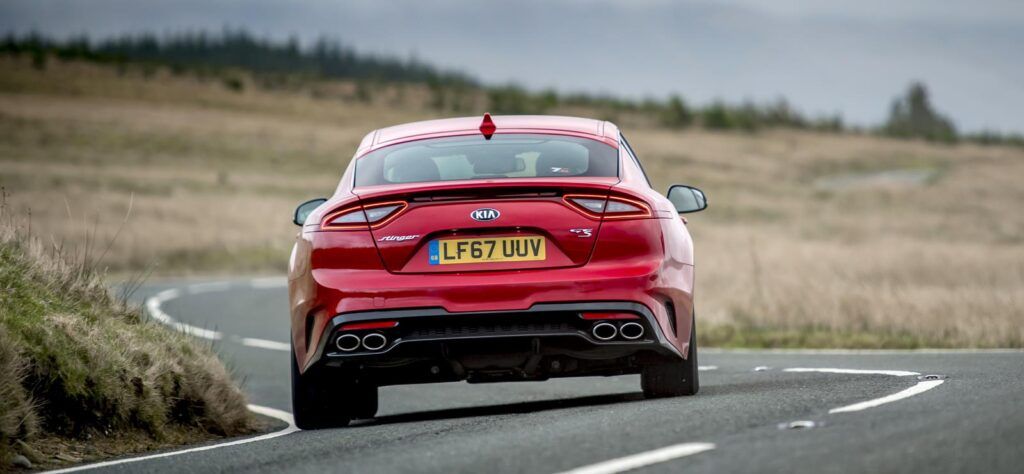
In the flesh, too, because the Stinger looks special. Vents and grooves carefully chiselled into the body put it somewhere between muscle car and sports tourer. Touches of chrome around the body keep it bright, drawing the eye back and forth along the sweeping lines. The quad exhausts and the bright red Brembo brake callipers let you know this car is not messing around.
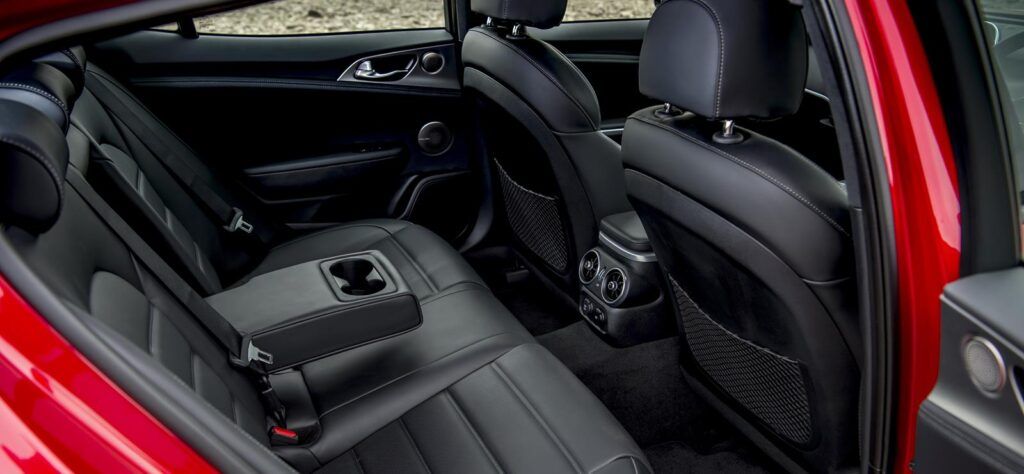
The story continues inside, with Nappa leather upholstery throughout and front heated and cooled seats (the rear seats are heated only). I wasn’t sure at first about the value of the cooled seats, but as the days went by, a cooled seat became the new something I didn’t realise I’d always needed.
There’s a premium feel throughout the cabin, too, with a soft-to-the-touch dash and door frames that feature stitching to give an impression of craftsmanship. The D-shaped steering wheel feels sturdily luxurious and comes heated as standard.

The Stinger is full of technology, too, with far too much included as standard to list here in full. Stand-out features include the head-up display (HUD), which is customisable and reflects information onto the windscreen in an unobtrusive manner. I set it to show the speed limit plus the speed I was actually going; other useful information did flash up from time to time, like the blind-spot warning (which also flashes up on the wing mirror) and the collision detector.
Whilst on the subject of the HUD, I really appreciated how, when flipping the Stinger into sports mode, my speed would be displayed in italics. And talking of nice touches, putting the car in reverse automatically dips your wing mirrors and brings up the rear parking camera on the central display as well as the 360-degree view, all of which makes parking a doddle.
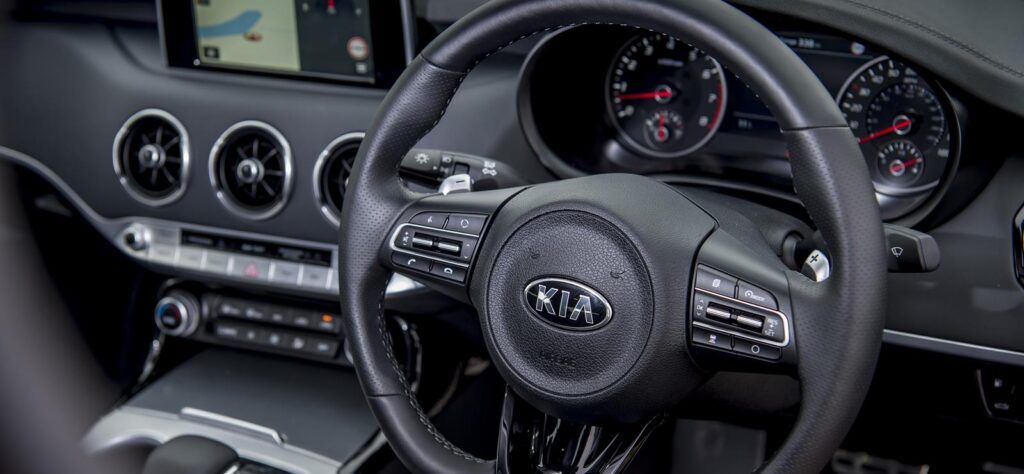
The 8.0-inch infotainment system is easy to use and comes with Apple CarPlay and Android Auto, as well as Bluetooth streaming to the premium sound system. There’s a nice little welcome and goodbye tune that I enjoyed, but I could imagine it would become tiresome if you make frequent small journeys, although this can be switched off.
Yes, not only do you get the HUD and the central infotainment, but you also get myriad options in the driver’s screen, which can be used to customise your HUD, your welcome tune, and your lap timer (in case you fancy a race day, and why wouldn’t you?). I opted for mine to be on the real-time G-force spider diagram, which shows how many Gs the car pulls under acceleration.
Getting comfortable in the Stinger is not a problem at all. The front seats boast plenty of customisation options: the base and backrests can be tilted independently, the whole seat can be raised or lowered, and the lumbar support can be adjusted, as can the side bolster. With so many options, it’s reassuring to know you can save two different seating positions.
The steering column has plenty of movement, too, all electronic rather than the old lever action. With the Stinger sitting pretty low, another nice touch sees the seat slide back to give a bit extra room when opening the door to exit/enter.
The 366hp 3.3-litre engine is amazing, being smooth and responsive, with the eight-speed auto box (with paddle-shift) offering predictability in all modes. The engine manages to get the Stinger from 0 to 62mph in 4.7 seconds, which is no mean feat considering the Stinger is a bit heavier than some rivals like the Audi S5. The steering is spot on, and the Stinger sits nice and low, hugging the road even when pushing it in sports mode. If you’re feeling more adventurous, there is the option of Sports+ mode, which removes the traction control completely…

In terms of practicality, the Stinger continues to score points. The boot is a decent size (406 litres), which might be marginally smaller than an Audi S5 but goes up to a decent 1,114 litres with the seats down, making it marginally bigger than the S5 in the same position. There’s plenty of storage and cubby holes throughout and plenty of room in the back; only those north of six feet will have any problem with headroom due to the sloping roof.
With the engine on offer, it’s unsurprising that the economy is pretty low, with a combined 27.7mpg being stated by Kia. This is pretty poor for this class, and around 10mpg lower than the S5, which might lead to increased running costs, so it’s worth remembering that all Kias come with that seven-year/100,000-mile warranty as standard.
The Stinger is beautiful in almost every way; it gets so much right, and where it does get things wrong (like the fuel consumption), it’s for the right reasons. If you are in the market for a powerful executive car in this price range, the Stinger needs to be considered.

- Driven: Rolls-Royce Ghost Series II — Luxury evolved - 6 May 2025
- Driven by vision: The Aston Martin Lagonda Series 2 revisited - 22 April 2025
- Ogio Introduces Limited-Edition Agave Ahora Golf Bag Collection - 25 May 2024