
There’s an unwritten rule about concept cars. Those that get wheeled out to rapturous applause at motor shows very rarely make it into production. And those that do are inevitably a pale imitation of the bold, confident shapes hewn from the designer’s modelling clay. So when Audi unveiled its striking TT Concept at the 1995 Frankfurt Motor Show, everyone assumed it would be business as usual — more eye candy destined to languish in a basement somewhere while the company kept churning out sober-suited executive saloons.
Except this time, they were wrong. The production Audi TT arrived barely three years later, virtually unchanged from the original concept penned by German-American stylist Freeman Thomas at the Volkswagen Group’s design studio in Simi Valley, California. It had the same strikingly clean silhouette, the same pert, low-slung stance and the same immaculate proportions. It was unlike anything else out there at the time — a slice of Bauhaus minimalism for the mainstream.
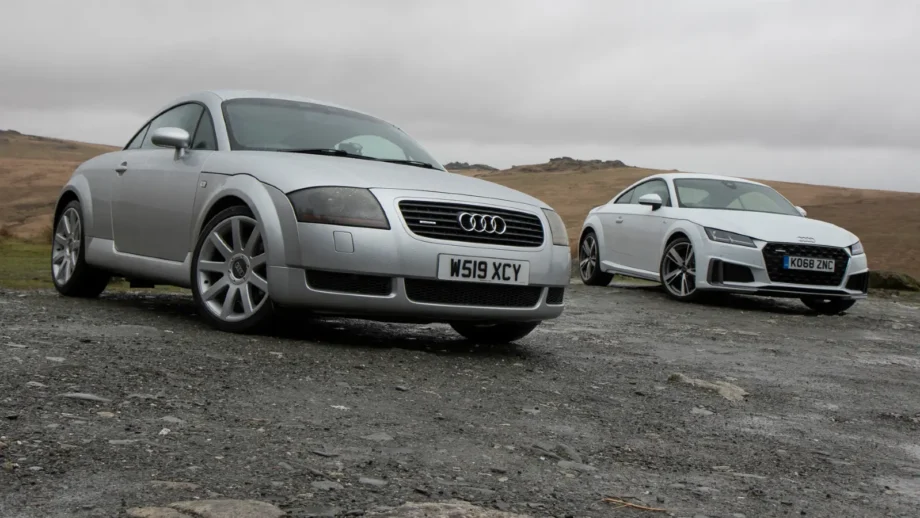
Some 21 years later, the TT is now well into its third generation. It was freshly facelifted at the beginning of 2019, with a new range of engines and a series of styling tweaks. But can it still capture the original car’s appeal? To find out, we’ve brought together the very latest 245hp TT quattro coupe and an immaculate Mk1 TT 225 quattro.

Mechanically, both are based on platforms shared with everyday hatchbacks — notably the Audi A3 and the Volkswagen Golf — but several generations separate them. Arguably, the TT has suffered from its own success a little in that time; styling cues taken from the original design have since been applied right across the Audi range, rendering the current car a little more generic through no fault of its own. The same unmistakable Audi TT profile remains, though, with that clean, swooping roofline and the bubble-shaped canopy.
There’s a purity to the older car that the current TT can’t quite match. It’s as if the designers have had to add features over time, whereas the original team were tasked with keeping everything as clean as possible. Nonetheless, it still feels relatively uncluttered by modern standards. That’s particularly true inside the cabin, with Audi’s brilliant virtual instrument cluster now handling the infotainment functions. This succeeds in delivering an upmarket feel without requiring one of the giant touchscreens that seem to blight a lot of modern dashboards. Even the seats on our S-Line edition are a work of art — sparingly padded yet beautifully comfortable and wonderful to behold in their quilted pattern.

You can see some of the same thinking in the original car at work. For instance, the stereo (complete with a tape deck) is hidden behind a folding panel to prevent it from disturbing the minimalist lines of the dashboard. In other respects, though, it’s a more playful design. There’s a slightly steampunk feel to dimpled aluminium circles that are repeated throughout the cabin and the polished metal struts that run down by the gear lever.
On the road, the similarities between the two cars are more striking than the differences. I wondered if the Mk1 would be more visceral, but both are remarkably polished. The four-cylinder powerplants have the same effervescent feel — neither of which feels or sounds especially turbocharged. The modern car is substantially quicker — aided by a 90Nm increase in torque and a 100kg weight reduction that amplifies its modest 20hp power advantage. Yet the fact you have to work the older car harder makes it more satisfying in some respects. Initially, the obviously synthesised engine sound you get with the modern car in Dynamic mode grates somewhat, but it adds a bit more menace to the soundtrack (and you can always switch it off).
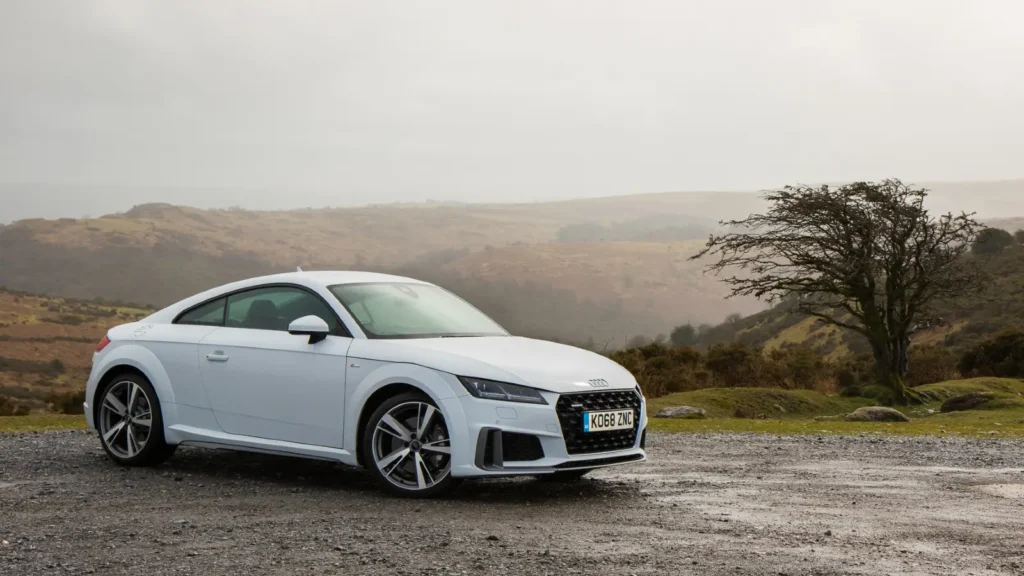
The Quattro-equipped TTs have always been quick off the mark, with the current 245hp coupe good for 0 to 62mph in 5.2 seconds. Traction is seemingly absolute, even in the damp conditions of our test, enabling the TT to dissect a twisty road at a pace that would humble a lot of more serious sports cars.
In both models, the steering is quick to respond, although it can sometimes feel a little aloof. However, you soon learn to trust the TT’s keen turn-in and prodigious grip, making it a supremely confidence-inspiring car to drive quickly.

For some drivers, this unflappable nature will be the Audi’s undoing. The sort of throttle adjustability you get in a good rear-wheel drive coupe, or one of the more lively hot hatches simply doesn’t exist here. If you can say hand-on-heart that you regularly get to drive with that sort of enthusiasm, then this probably isn’t the car for you — but there’s actually something rather liberating about driving a car that you can really push hard, safe in the knowledge that there are absolutely no nasty surprises lying in store.
Ultimately, the key to the TT’s appeal has always been its sense of occasion. Two and a bit decades later, it still looks like a concept car that has slipped its chains and broken free. Starting at £31,565, it also occupies a unique space in the market — more affordable than the Porsche Boxster or the new BMW Z4, more upmarket than the Mazda MX-5 or the Toyota GT86 and more eye-catching than a conventional saloon or hatchback. It’s an enduring recipe. And one that still works well today.

- Driven: Princess S78 Luxury Yacht Review - 28 January 2021
- The Fastest Man on Earth - 8 July 2020
- Driving Senna’s Supercar: The Honda NSX - 31 August 2019