
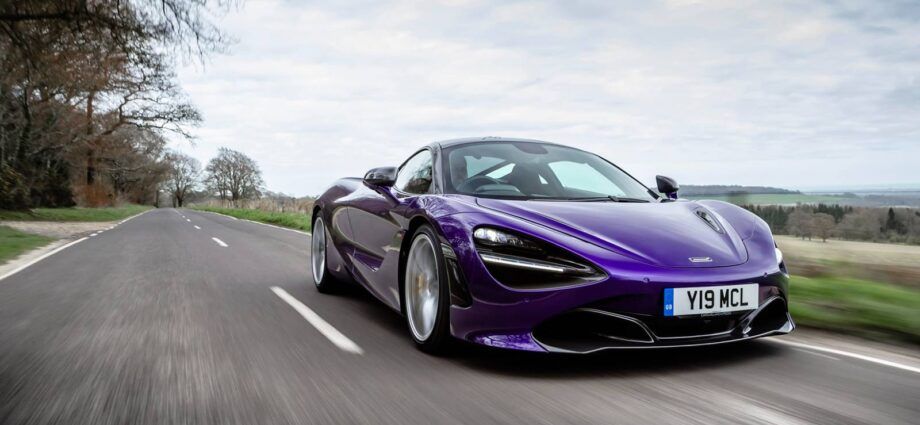
Some legendary names from the motorsport world have taken the bold move and started building road cars, explains Chris Lilly. The likes of Ferrari, Bentley, Aston Martin, and Porsche all boast a proud heritage built on trophies won on the track, something that inevitably boosts the appeal of their road cars. And yet, despite McLaren having a racing history that is every bit as illustrious as those mentioned above, its background in road cars is relatively recent.
But it’s certainly making up for lost time. Ignoring the McLaren F1 — and a dalliance with Mercedes-Benz for the SLR — McLaren only started making road cars on a large scale around a decade ago with its first full-production supercar — the MP4-12C, later shortened to just 12C. The 720S is quite a few steps forward from McLaren’s initial offerings and sets the British manufacturer up to go toe-to-toe with its contemporaries.

The second of McLaren’s Super Series, the 720S sits above the 570 models in the Sports Series, and beneath the Senna. The latter car forms part of McLaren’s Ultimate Series, a category reserved for its very fastest hypercars.
And, if the McLaren’s power output is anything to go by, ‘Super’ seems an apt adjective for the 720S. (The digits in the badge refer to the amount of horsepower the 4.0-litre twin-turbocharged V8 produces.) That power is backed up by 770Nm of torque from the advanced engine, which is installed amidship. Power flows through a seven-speed dual-clutch gearbox to the rear wheels.
It’s quick, then. Chuffing quick, if you’ll excuse the potty mouth. The 0-62mph sprint is dispatched in 2.9 seconds. Double that speed is passed in only 7.8 seconds, and the McLaren 720S tops out a good 12mph beyond the figure needed to be part of the illustrious 200mph club.
However, statistics only tell part of the story, and the power plant behind the 720S is supported by a new version of McLaren’s carbon-fibre tub, the Monocage II. It allows for a power-to-weight ratio of 561hp per tonne but, more importantly, it keeps weight to a minimum, which helps the handling no end.
The Monocage II partners with new suspension and an updated Proactive Chassis Control system to create an extremely light, strong, and versatile set-up. It’s a good foundation on which to build a car, and McLaren has wrapped the chassis in stylish bodywork that looks good in photos, better in the metal, and fantastic when up close, where you can see all the trick details that manipulate the airflow beneath the surface. It’s a design that puts in some hard graft, working the air through channels and vents to keep the 720S stuck to the road without needing large wings, flicks, or flaps.

There is a rear wing, but it is blended so smoothly into the exterior surfacing that you forget about it until braking hard, where it pops up in the rear-view mirror as an airbrake, another area where the McLaren 720S excels because it scrubs speed off even more quickly than it accumulates it. Yet, despite their power, the brakes have a progressive, substantial feel to them, even after a bit of a pummelling. In that regard, it is closer to a racing car than a road-going model.
Nor is it a straight-line monster because the 720S is beautiful to drive, with a surprising suppleness to the springs and an agility that allows you to dart around bends at speed. There is no way you can push the limits of the McLaren on the road; it would require both illegal speeds and an attitude that has moved far beyond bravery and well into the frankly idiotic.
Even on country roads, with random undulations and pot-holes seemingly designed to throw cars off balance, the McLaren is planted and astonishingly fast. There is plenty of feedback through the wheel to tell you exactly what the car is doing, and the precision in the steering is superb.
At this point, having extolled the virtues of the McLaren’s power, braking, and handling, there usually comes a huge caveat. Something along the lines of ‘but it’s clearly only designed for the track, and is completely impractical in the real world’.

That’s not the case with the McLaren 720S. The cabin is light, airy, and feels spacious, thanks to a largely glass canopy above the occupants. That Monocage II incorporates thinner upper components than before, improving visibility and the sense of airiness inside. The seats are comfortable, not rock-hard sculpted numbers, and capable of dealing with long trips without issue. That suspension soaks up imperfections from the road surprisingly well, to the extent that, despite the 720S being pitched as a focused supercar, it could easily double up as a highly competent Grand Tourer.
Granted, the controls could be simpler to use, but then there wouldn’t be the same capabilities to set up your engine and handling ‘just so’. Plus, a supercar should focus on driving rather than graphics or the speed of the sat-nav’s responses. The cabin looks great, works pretty well, and has enough space for a few bags of shopping or a couple of suitcases — if you pack light.
Then there’s the price. At almost £210,000 , you have every right to expect a lot — and the McLaren 720S delivers. It has packaged a car that is phenomenal to drive yet comfortable enough to (almost) be considered sensible.
The Porsche 911 might be the undisputed king of the ‘everyday sportscar’, but here we have the best ‘everyday supercar’ in the world.

- Driven: Rolls-Royce Ghost Series II — Luxury evolved - 6 May 2025
- Driven by vision: The Aston Martin Lagonda Series 2 revisited - 22 April 2025
- Ogio Introduces Limited-Edition Agave Ahora Golf Bag Collection - 25 May 2024