

The German Tiger I was the most feared battle tank of the Second World War. Its invincibility lay in its main 8.8cm gun and heavy defensive armour. At a hefty 57 tonnes, the Tiger was a massive machine and weighed more than twice its stablemate, the Panzer IV.
When the Tiger first appeared on the battlefields of the Russian Eastern Front and North Africa in 1942-43, it was likely to win any individual engagement with an enemy tank. Only once the Soviet T-34 and American Sherman tanks began to appear in ever greater numbers was the reign of the Tiger eclipsed, which eventually resulted in victory for the Allies.
At the Tank Museum in Dorset, the only Tiger I in the world has been restored to full running order. ‘Tiger 131’ draws crowds every year at the museum’s Tankfest and on special ‘Tiger Days’.
The Tiger Tank Story
An awful lot has been written and said about the German Tiger I for a tank that was used in relatively small numbers during the Second World War. It is tempting to view the appearance of the Tiger as revolutionary – as indeed it must have seemed to the many Allied soldiers who had to face it.
When looked at from the standpoint of history, and in particular engineering history, it was purely evolutionary – yet not always at the cutting edge of development and sometimes reactionary. However, the result was a machine that represented a quantum leap forward in tank design that was to change everything.
The Tiger was designed with a traditional layout but differed from other contemporary tanks due to its increased scale in areas such as gun size (8.8cm), its armour protection (up to 100mm) and the provision of deep-wading capability.

A prototype of the new Tiger was demonstrated to Adolf Hitler on his birthday, 20th April 1942, near Rastenburg in East Prussia.
The pressures of war had meant the design programme was rushed through, and a lack of trialling meant the tank was plagued by a string of mechanical problems that needed to be overcome and which slowed down production. Much of this was due to the fact that building a heavy tank like the Tiger was at the very limits of the technology and material strengths of the day.
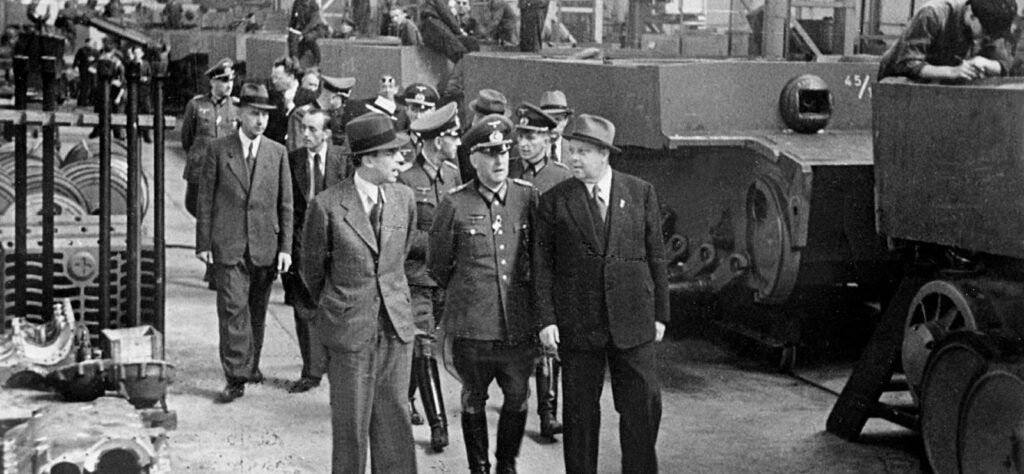
The armoured hulls and turrets for the Tiger were built by the German companies Krupp and DHHV, and the Maybach HL 210/230 engines by Maybach and Auto Union.
They were delivered to the factories of Henschel and Wegmann Waggonfabrik AG for final assembly, including painting and preparation for service. The remaining hulls and turrets were made up of refurbished battle-damaged vehicles with some new components added.
When the first Tigers were delivered to the German Army on the Russian Front near Leningrad in August 1942, three out of four were found to be inoperable. This led to a continuous series of modifications to the tank’s basic design to improve its poor reliability.
Records show that 1,354 Tiger tanks were built between July 1942 and August 1944, with the monthly total of Tigers increasing from 30 in 1942 to 104 vehicles at the peak of production in April 1944. By late 1944, a newer and larger model had assumed the Tiger mantle – the Ausführung B (better known as the King Tiger).
Snaring a Tiger
One Tiger tank, in particular, Serial Number 250122, rolled out of the Henschel works in February 1943. It was shipped to Tunisia in March to join the 504th Heavy Tank Battalion.
On 21st April, the Tigers of the 504th clashed with Churchill tanks of the British Army’s 48th Battalion Royal Tank Regiment (48 RTR) in a muddled engagement in the hills at Medjez-el-Bab. It was 48 RTR’s first time in action. As a result, the British lost two Churchill tanks, but a couple of lucky shots also disabled one of the German tanks, ‘Tiger 131’.
Quite what happened, and quite how much the damage affected the Tiger and its crew, is not easy to historically assess. The German War Diary gives its own take on the event: ‘The crew members of TIGER 131 panic and abandon the tank after two harmless hits from a CHURCHILL’.
The British subsequently captured 131, realising that a Tiger tank in relatively full working order was quite a prize, so keeping this particular Tiger intact and in running order was considered to be of paramount military importance.
Recovery of the tank was entrusted to the 104th Army Tank Workshop, so Tiger 131 was eventually shipped back to Britain for evaluation, where it arrived at the Department of Tank Design in Surrey on 20th October 1943.

Lieutenant Peter Gudgin, a troop leader in 48 RTR, had been wounded when his Churchill tank was knocked out in North Africa and was invalided home to Britain. Once recovered, he was posted to the School of Tank Technology at Chertsey.
By a bizarre coincidence, he found himself responsible for writing an intelligence report on the very tank that had nearly killed him – Tiger 131!
Closer examination of 131 later revealed that its gun turret had been jammed by a burr from the armour protecting the turret ring being forced up by an artillery strike. The Tiger’s radio was also shattered by the round, which split the weld on the top plate and may have also incapacitated the driver and front gunner. Problems with the engine overheating were also revealed.
So, with incoming fire, a jammed turret, no communications, and an overheated engine, perhaps the Tiger crew had no choice but to abandon their temporarily immobile vehicle.
Detailed reports were written on the Tiger’s armament, the fighting compartment, stowage and the power traverse systems, as well as on the engine and transmission of the tank before Tiger 131 was handed over to the Tank Museum at Bovington, Dorset, by the Ministry of Supply in 1951, with much other captured equipment.
Reviving a Tiger
During the 1980s, Tiger 131 was considered such an iconic vehicle, despite its missing parts and overall complexity, that it became a Tank Museum goal to return the vehicle to full working order. The decision was taken to try and return the vehicle to as near to its state at capture as possible with, as might be expected, certain compromises.
The restoration project was carried out by staff within the museum, with modest grants made by the Winston Churchill Memorial Trust to research the history of the tank. A number of defence companies and related industries also came forward to offer assistance. Eventually, the museum decided the best way forward was to secure Heritage Lottery Funding (HLF) for restoration to return the Tiger to running order.
An issue that caused some concern was the rebuilding of the HL230 engine, regarded by many as the Tiger’s Achilles heel. With the Tank Museum’s oversight, the Tiger’s Maybach engine was stripped and rebuilt by the SdKfz Military Vehicle Foundation before being returned to the museum and giving 131 a much smoother-running engine.
The restoration of Tiger 131 was completed in 2005, with the tank becoming fully roadworthy, but, in many ways, the restoration of such an artefact as a Second World War tank will never be truly complete.
More original components may come to light, and there are a number of areas that were not restored or reinstated in the original HLF-sponsored restoration to be addressed. These additional changes will help bring the vehicle back to a state of completeness representative of its condition at capture in 1943, creating a more authentic and complete vehicle.
Running the tank will have obviously caused wear and tear, so the museum is using the opportunity of further works to investigate the effects of operating such a historic vehicle.
Whether Tiger 131 continues to run into the future is a matter of continuous assessment. Knowing the vehicle’s appeal and the huge interest in seeing the tank run at Tankfest and on the special Tiger Days, the museum would want it to continue running and wowing the crowds.
The tank will stay static if wear, breakages, and risks are considered too great. If wear rates and risks are considered acceptable, the museum will hope to run the vehicle for set periods before another major investigation. With careful stewardship and a measure of good luck, Tiger will continue to thrill the crowds for many years to come.
Abridged from the Haynes Tiger Tank Owners’ Workshop Manual, published in association with the Tank Museum, Bovington.

- Driven: Rolls-Royce Ghost Series II — Luxury evolved - 6 May 2025
- Driven by vision: The Aston Martin Lagonda Series 2 revisited - 22 April 2025
- Ogio Introduces Limited-Edition Agave Ahora Golf Bag Collection - 25 May 2024