

Louie Linken was having a very bad day, explains Georgia Stephens. A criminal rum runner during Prohibition, he was on a cross-border delivery from the Yukon to Alaska in the Arctic Circle with his brother Otto when they ran into a storm. Directing his dog team in the deluge, Louie momentarily slipped off his sled and watched with horror as his foot plunged into the icy water of a river overflow. There was no time to stop and dry off — the law was on their tail.
By the time they made it back to their cabin outside Dawson City, Louie’s big toe had frozen solid. Otto proposed the only sensible solution: to break into their illicit store of overproof rum, get Louie sozzled, and hack the offending appendage off with a wood-cutting axe. In the Twenties, the threat of gangrene loomed large. With the deed done, the brothers displayed the dismembered digit on a shelf in their cabin, immortalised in a jar of strong alcohol.
These days, Dawson City is still much as it was in the days of the Linken brothers. Second Avenue is a row of gently crumbling false-fronted buildings, some gaudily painted, others weather-worn and decaying, all leaning according to the whims of their shifting permafrost foundations. Back in 1898, they were constructed in haste by the 30,000-odd prospectors who made it up here for the Klondike Goldrush, and now they echo with the town’s rag-tag frontier past.
Up in the hills, hills that are still scattered with staked claims, you’ll find the ruins of historic dredges, and after hours it’s common to encounter gold miners cavorting with cancan dancers in the saloons. And yet there’s a feeling of a perfect, almost heavy, stillness to Dawson, the result of its remote position deep in the Arctic wilderness: Whitehorse, the Yukon’s capital city, is a frigid six-hour drive to the south, during which you’ll be lucky if you pass a single car.
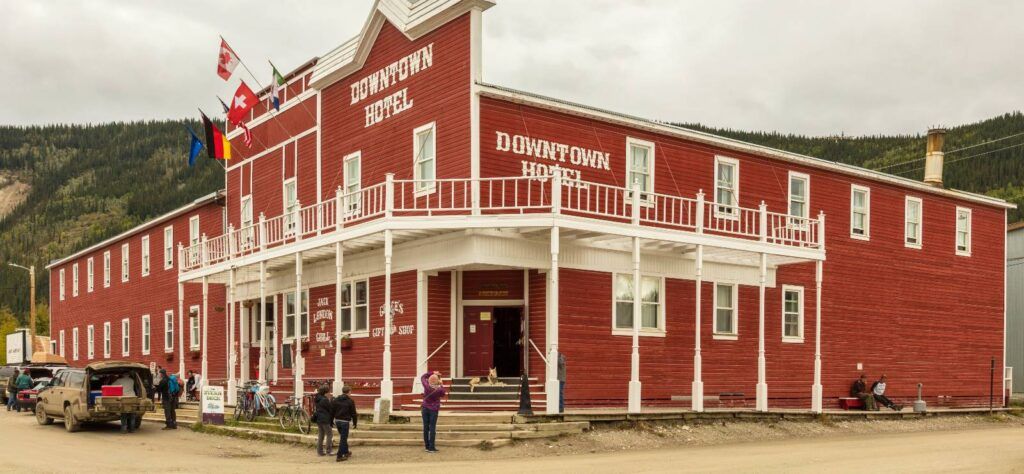
The air glitters with the impossibly fine flakes of snow being dislodged by the light breeze. It’s nudging forty below as I trudge across the town’s icy wooden boardwalks and cross its gravel roads, but I’ve heard temperatures in the winter here can drop as low as -60°C. I’m on my way towards the hulking red-and-white frame of the Downtown Hotel, where rumour has it there’s a toe behind the bar.
Back in 1973, Dick Stevenson, a local riverboat captain, made a peculiar find when he was cleaning out an abandoned cabin in the woods: a frostbitten toe sitting at the bottom of an ancient jar of amber rum. Something had to be done with it, and Captain Dick, being an imaginative man, paired it with alcohol and created Canada’s most controversial cocktail. The Sourtoe Cocktail was born.
And yet, even stranger things have happened in Dawson, a town whose festive roster includes the Great Klondike International Outhouse Race and “bum darts”. As far back as 1907, Bard of the Yukon Robert Service himself noted, “there are strange things done in the midnight sun by the men who moil for gold.” It comes from his ballad The Cremation of Sam McGee, in which a long-suffering Tennessean is driven mad by the frigid temperatures and asks to be set on fire upon his death to warm up.
The cold does funny things up here.
Locals have a name for people like Captain Dick: the colourful five percent. “It’s the people that make the town unique,” resident Yukoner Jesse Cooke had told me the day before. “It’s a personality thing, an attitude thing, an outlook on life, I suppose. Sure, you have your gold miners and your free spirits and artists here for the adventure, but then you have the people seeking to get away from it all – we have people living on the outskirts in cabins and tents and caves and all kinds of strange situations. They are definitely part of the colourful five percent. They make us what we are.”
Dawson is shaped by its people and the rhythm of the seasons, inhabited predominantly by snowbirds who flee south in time with the winter’s plummeting mercury. But the Sourdoughs remain – a nickname for the tough year-round residents who stay from freeze-up to break-up – to fully embrace Dawson’s chilled pace of life and rugged northern culture. But if you’d rather skip this step and become a Sourdough in name alone, all you have to do, says Captain Dick, is kiss the Sour Toe.
Over in the Downtown Hotel, the gruesome Sourtoe Cocktail is served with a spirit of your choice. I order mine with tequila and stifle a retch as the key ingredient is revealed ceremoniously from behind the bar: curled and crisp on a bed of coarse rock salt, black at the knuckle and graduating to a sickly yellow towards the nail. But it’s an imposter toe, not Louie Linken’s; his only lasted eight years following its discovery, said to have been accidentally swallowed by an inebriated miner tipped backwards on his bar stool.
Replacements trickle in from across Canada every time a prize digit is lost, medical – and occasionally accidental – amputations: one arrived in a jar with a note that read, “don’t wear open-toe sandals while mowing the lawn”. But as toes change, one rule remains the same: “You can drink it fast, you can drink it slow, but your lips must touch the toe.”

- Driven: Rolls-Royce Ghost Series II — Luxury evolved - 6 May 2025
- Driven by vision: The Aston Martin Lagonda Series 2 revisited - 22 April 2025
- Ogio Introduces Limited-Edition Agave Ahora Golf Bag Collection - 25 May 2024