
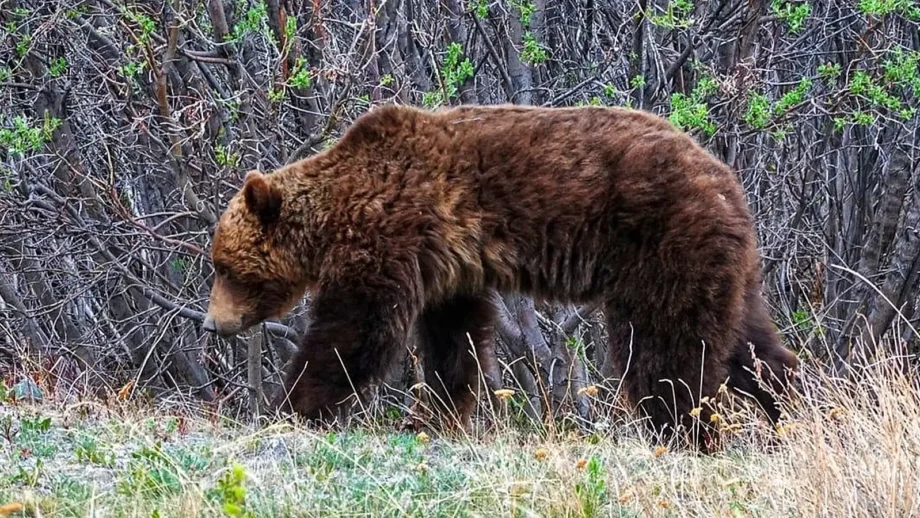
My pre-travel preparation mainly consisted of making sure that my passport was in date, that my bank knew I would be travelling for a couple of months, and researching the problems posed by facing bears. I knew, or at least thought I knew, that brown bears were more of a problem than black bears, but other than that, I was clueless.
I spent a happy hour or so looking at the difference between black bears (ursus americanus) and brown bears (ursus arctos). Other people can run through what the actual differences are more comprehensively than I can, so Google is your friend . Knowing the difference and being able to correctly identify them even when you’re shaking with adrenaline and scared witless is a lifesaving skill because, broadly speaking, black bears are amiable idiots that will run to avoid a confrontation, while brown bears (aka grizzly bears) are more aggressive by nature and may well attack anyone or anything they see as a threat.

So, I learned that you should make a noise when you walk, run or cycle to let any bears in the vicinity know you are there. Almost without exception, they will move away — and you’ll remain clueless about how many are lurking in the woods. I fitted a small ‘bear bell’ to my bike, which tinkled merrily as I cycled along, and I didn’t see a single bear in 200 miles of pedalling. (The trouble is, it scares everything else off, too, so you pay your money, etc.)
I was wandering through the woods searching for somewhere to have a pee — sans bell — two young black bears and I met up. I’d forgotten to make a noise, and they had been distracted by play fighting with each other. I’m pretty sure I was the more shocked of us all, but it was a close-run thing, and they charged off in one direction while I backed away in another.
I’d got that right, at least: you should never turn your back on a bear, and under no circumstances should you turn tail and run. Doing so might well trigger a bear’s prey drive, and it might stop seeing you as a problem and start seeing you as a meal.
I was wild camping there that night, and one or both of them came calling again in the early hours. I was too tired to do much more than shout at it/them to bugger off. Tiredness makes heroes of us all, and it/they ran off, crashing through the undergrowth and making a helluva racket.

I’d been careful to stash my food in a dry bag hung from a tree well away from my tent, and I’d also cooked in a separate spot. One piece of advice I’d heard was to imagine a triangle: put your tent at one point, your cooking area at another at least 100 feet away, and string your food bag high up in the trees 100 feet from that. The result should be a triangle with three sides, all of which are a minimum of 100 feet apart. It seemed like a sensible piece of advice, and I followed it religiously. If there are dedicated bear boxes, then use them.

The other key point is that some bears are habituated to campers, and they’re used to finding scraps of food that have been carelessly or deliberately left out for them to eat. This means that, somewhat counter-intuitively, organised campsites can pose more of a risk than wild camping in the middle of nowhere. Every province has semi-organised campsites, which cost — in Canada, at least — around CAN$13 (£7) a night. For that, you get firewood, a long-drop toilet, and some fancy notices telling you what you can and can’t do. In one of the larger ones, I had to set up camp within an electrified compound, as bears had become a problem there.
So, while camping in the middle of nowhere by yourself feels risky, it might not be as much of a problem as camping somewhere bears have learned to equate people with food. (As the old saying goes, ’a fed bear is a dead bear’. Never, ever feed bears. If you do, they will lose their fear of humans and, as a consequence, will almost certainly end up getting shot.

Speaking of dumb things to do, please don’t get out of your car to photograph a bear. They pretty much ignore cars, having learned that they rarely pose a threat. So, when you pull up to admire them, they’ll carry on munching away (a grizzly spends almost every waking moment eating) quite happily. This means you can get out of your car and get within a couple of metres of one of the most dangerous animals on earth without it realising you’re there. Until it cottons on, charges you, and mauls you in the process. So just don’t, okay? A decent camera with a moderately long lens will get you all the close-ups you need, all taken from the safety of your car with the window cranked down just a little.
If it all goes wrong, bear spray is widely available for around CAN$30 (£16). I crisscrossed the American/Canadian border a few times, always declared it and never had an issue. You can buy it in almost every outdoor shop, and the staff there will register your purchase (it’s a fearsome weapon, after all) and advise you on how to use it. I carried mine everywhere (you can see it at the bottom left of the photograph below) and, luckily, never had to use it. But I did practice getting it out of the holder, removing the safety clip, and pretending to press it. Muscle memory is what saves you when your body is flooded with adrenaline and you’ve lost your fine motor skills.

Bringing bear spray into the UK is a serious firearms offence, and you could face a decade or more in prison, so don’t be tempted to bring it back as a souvenir. The right way to dispose of it is to take it to a police station in Canada and ask them to get rid of it for you. Oh, and leave it in your car and go in first and tell them that you’d like to bring it into the police station; even the usually laidback Canadian cops are likely to get twitchy when faced with someone carrying a can of pepper spray.
If you are charged (by a bear, not the cops), it’s important to stand your ground, no matter how much you want to run away. If it’s a black bear, make yourself as large as possible and make threatening noises. As I can attest, ‘Fuck off!’ works very well, is easy to remember under moments of stress and should scare most black bears away. (Also, unlike most Canadians, black bears seemed to have no problem understanding my English accent, being the one demographic I didn’t ever have to repeat myself to.)
If it’s a brown bear, stand your ground but look down instead, and make yourself as small and unthreatening as possible. A whimpered ‘I’m sorry’ might help — and you should never make eye contact with a grizzly because they will see it as a challenge. I don’t care how big and tough you are; a grizzly bear is bigger and tougher.
In the unlikely event of a black bear attacking you, then fighting back is the order of the day. Grizzlies, on the other hand, apparently won’t continue to attack a dead person, so playing dead is your best bet. Curl up and protect the back of your neck and head with your hands. Only fight back if it continues to attack because if it does, it probably sees you as food rather than a threat, and you’ve got nothing to lose by trying to scare it away.
But please don’t worry too much because bear attacks are incredibly rare; I walked, ran, and cycled for six weeks out here in all sorts of wilderness terrain and didn’t ever feel threatened or feel that a bear was going to cause me a problem, even when I was wild-camped hundreds of miles from the nearest town. In fact, a town centre on a Friday night will pose a significantly greater danger to your well-being than a bear ever will…

- Winter Reading: Books for the Wilderness - 25 January 2023
- Kit Review: Mountain Hardwear Super/DS Stretchdown Hooded Down Jacket - 6 January 2020
- Tested: Outwell Dreamboat Mattress - 29 October 2019