

The plan was simple: buy a Trek 920 and then cycle from Vancouver to Dawson City via Jasper and Whitehorse. It would be a minimum of 2,000 miles, but I had four months to do it, which seemed like plenty of time, even for a 50-year-old like me.
Scouting the 920 in a UK-based Trek dealer, the sales assistant told me that the bike I really needed was the 1120, the 920’s delinquent, functioning-alcoholic step-brother. “Are you sure?” I asked. Oh yes, came the confident reply. Definitely.
While the Trek 920 is a relatively conventional drop-handlebar touring bike, the 1120 is an aggressive, aluminium-and-carbon fat bike with three-inch wide tyres, custom front and rear luggage racks, and a riding position that almost everyone says is too aggressive for extended road use.
It looks badass, though.

So, I bought a Trek 1120 from West Point Cycles in Vancouver (they were not the guys who advised me that I needed an 1120 rather than a 920). West Point Cycles did a tremendous job of setting up the bike, advising me on the spare parts I should take, and generally giving me the confidence boost I needed.
My kit was as light as I could make it: just one pair of cycling shorts, for example, plus one pair of Fjallraven Abisko trekking tights, two merino wool tops, a lightweight GoreTex jacket and trousers, plus an OMM synthetic down jacket and a spare pair of underpants and socks. A cycling helmet, extra-long merino wool buff, and a pair of cycling gloves completed my wardrobe.
A Snow Peak titanium mug, 900ml pan, and a spoon made up my cooking kit, along with a 17g titanium burner head and two small gas canisters. This little lot was held in a Salsa Anything Cradle and dry bag mounted on the left-hand front fork, while the other side held my washkit, again in a Salsa cradle.

Two handlebar bags held my toilet kit, sunscreen, bear spray, and solar power bank. A top-tube bag held bits and bobs like a passport, while a QuadLock phone mount held my phone, which was the only navigation I used bar a tiny roadmap. This might sound irresponsible, but there are only a few roads in this part of Canada and directions like ‘turn left and stay on the road for 500 miles’ were commonplace.
A small seat-mounted bag held a collection of bike tools, and my clothing was stored in a 10-litre dry bag on the offside of my bike. The nearside bag — again, 10 litres in size; the Trek website says that eight-litre bags must be used, but I found that slightly bigger ones fitted just fine — held food: up to six days’ worth would be needed for the Stewart-Cassier Highway, and two water bottles held half-a-days water. A Katadyn Pocket water filter meant I could make drinking water from even the foulest of ponds and puddles.
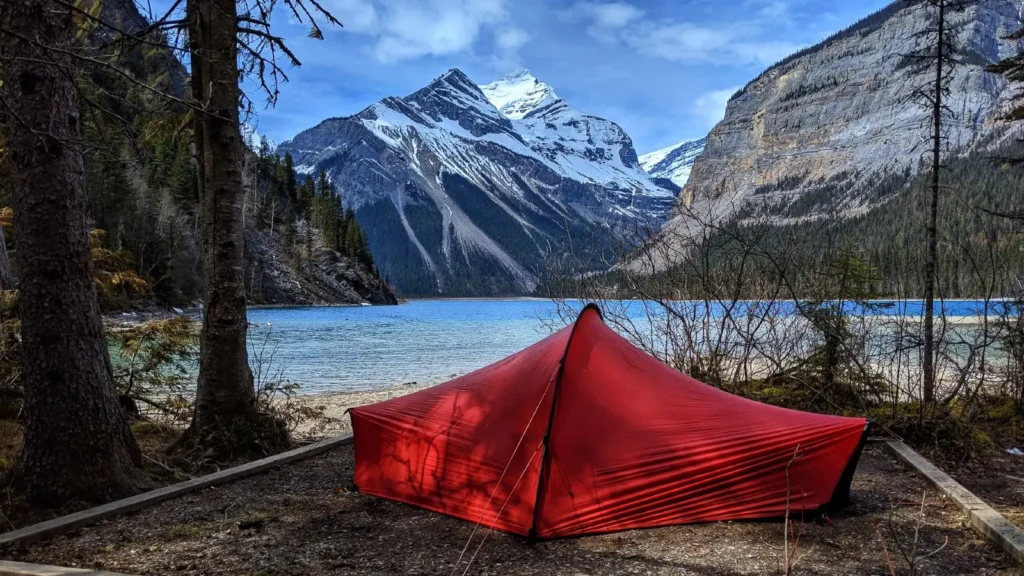
The front cradle held my Montane Prism synthetic sleeping bag, my NeoAir XLite sleeping pad, and my Hilleberg Enan tent. The Trek 1120 weighs about 15kgs (so not that light), and my camping kit weighed another 15-ish, although the food and water would bump this up significantly on the longer stretches.
The trouble was I needed to be able to work along the way, which meant taking a GoPro rucksack with a laptop, charger, mouse, camera, GoPro, leads, and all the other stuff that a mini-office requires. This added another 15kgs or so, which meant that the bike, fully loaded with food and water, weighed a little over 50 kilos.

This is too much. I lifted it — just — onto the train in Vancouver, but it was hard going.
However, it was worth it because the VIA train from Vancouver to Jasper might take almost 24 hours, but it only costs $150 (£90) for a seat (shared cabins go for $1,000 (£600) and more, but aren’t necessary given the huge legroom on offer), which makes it one of the great Canadian bargains. We saw black and grizzly bears, moose, elk and possibly a coyote. Throw in some of the business’s nicest, most friendly staff, and my cycling holiday started with a bang.
It went downhill from there.
I managed 58 miles on my first day, even if the final five or so saw me pushing the bike uphill through mud and snow to get me to the most spectacular camping spot of the trip at Kinney Lake. The water was an incredible turquoise blue, and the snow-topped mountains and lakeside forests meant that my first wild camping experience in Canada was one I’ll never forget. A bear even came calling in the night, but I was too sleepy to do anything other than to tell him to bugger off; tiredness makes heroes of us all, eh?
On the second day, I covered 55 miles and just under 60 on my third. At which point, I freewheeled four miles downhill and flagged down another VIA train into Prince George and abandoned my bikepacking holiday in favour of a rented Ford F-150 pickup and day-trip rides only. Flagging down rural trains is acceptable, incidentally. Expected, even. And the staff on this one were so friendly I ended up going out for beer and nachos with them.
It’s not just that the Trek 1120 isn’t a good long-distance bikepacking bike. (Although it isn’t.) Nor is it that the saddle is too hard and the riding position too aggressive. (Although both are true and hugely problematic; my left hand still tingles after three days of supporting an awful lot of my body weight.) Nor is it that the bike weighed too much, even sans luggage. (Although it does.) Nor was my fitness an issue. (Although I could have been fitter, the training effect of long days in the saddle meant I was getting stronger even in the three days I was cycling.)

No, the main problem was that damned work bag. The extra 15kgs really held me back, even on modest downhill stretches where I still needed to pedal to maintain forward motion. Without it, I’m sure the Trek 1120 would have been an okay bike; not as good as the 920, for sure, but okay.
It has some good points. The 11-speed, single front-chainwheel gearing is fine. Sure, I spun out on the downhill sections, but the lowest gear was low enough that balance, rather than gearing, became the issue on long, steep uphill sections. Everywhere else, I could spin and spin and spin, which any long-distance cyclist will tell you is the key to making good progress.
Those funky front and rear panniers work, too, even though I’m not sure they offered any advantages over a more conventional set-up. But, the bend in the handlebars means the grips are too low, and the dropper seat-post seemed like a bit of a waste of weight and money to me. Oh, and the handlebar grips themselves are horrible, being hard and unyielding and unworthy of a bike that costs £2,400. Without pedals.
The Salsa Anything Cradles were excellent and the perfect size for what I wanted them for. Ditto, the handlebar bags, which made quick loo stops easy and kept my bear spray to hand. (Not that I needed it; the bears, except on the first night, kept their distance.) The navigation via ViewRanger was excellent, too and was easily comprehensive enough for pan-Canadian travel. I kept a log of my routes, which showed average speed, height gained and lost, and the ability to retrace my route backwards should I have become lost.
I also carried a McMurdo FastFind 220 personal locator beacon. At £220 it was, for me anyway, cheap insurance; I knew that if anything serious happened to me, from a bear attack through to severe illness or a road traffic accident, I could press a button and help would arrive, albeit later rather than sooner given the remoteness of the areas I was travelling in. It’s highly recommended and a must-have if you are travelling in remote areas. The battery life is five years, so it’s less than a pound a week, which seems cheap.

So, the learning from the trip is a) stick to your guns and not let a Trek dealer talk you into spending hundreds of pounds more on a less suitable bike, and b) don’t take a mobile office bike-packing with you.
I’ve since used the 1120 on rough side roads and unmade trails all over Canada and can confirm that it makes a fine day-touring bike.
But still not a better one than the Trek 920. Or even the Surly Long Haul Trucker.

- Winter Reading: Books for the Wilderness - 25 January 2023
- Kit Review: Mountain Hardwear Super/DS Stretchdown Hooded Down Jacket - 6 January 2020
- Tested: Outwell Dreamboat Mattress - 29 October 2019