
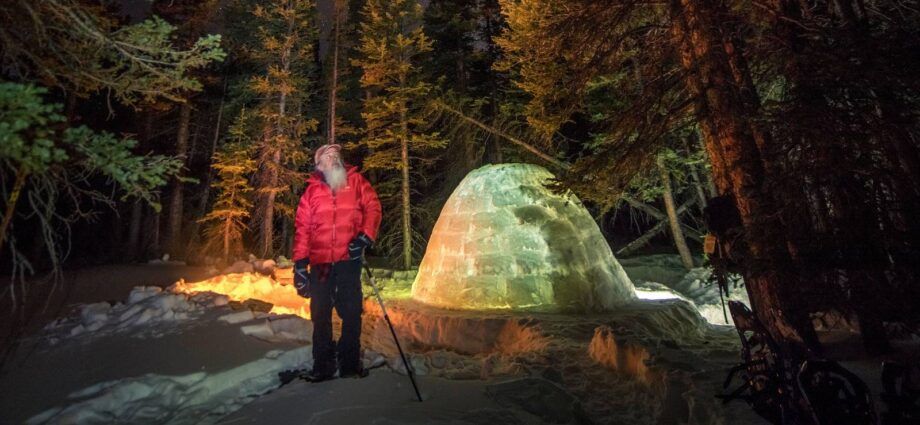
It’s mid-winter in Rocky Mountain National Park and the wind-whipped frozen air bites like peppermint as it roars off the Continental Divide. Since we’ve snowshoed into the backcountry without tents — to sleep overnight at 11,400 feet while clinging to the side of an icy mountain — I figure that makes us the coldest darned fools in Colorado, says Ted Alan Stedman.
But it’s not the dire predicament you’d think. I’m with Ed Huesers, better known as Igloo Ed, and he assures me that not only will we survive our winter camping ordeal, we’ll do it in style, staying warm and dry no matter what Old Man Winter throws at us.

Our salvation is Huesers’ creation, the Icebox snow shelter tool, a compact igloo-making device that’s among 25kgs of winter backcountry gear we’ve each packed in. If all goes according to plan, in several hours, we will be comfortably hunkered down in a real-deal igloo, protected from the elements by a spiralling stack of rectangular 20cm-thick snow blocks of our own making.
“Igloos are warm and quiet,” he says while assembling the 2.5kg contraption that resembles a plastic three-ring binder with an attached telescopic aluminium pole. “You can stay dry inside an igloo because the air is warmer than freezing, usually between 1 and 3°C.”
A sturdy man with a flowing beard, Huesers grew up in North Dakota and began his love affair with winter by building snow caves as a kid. “We made quinzhees, a mound of snow you hollow out for shelter,” he recalls. “But they could collapse and were dangerous, so I began thinking about other snow shelters.”
After moving to Lyons in 1975, Huesers began studying the dynamics of the physics of snow. Instead of excavating icy snow blocks, as Native Inuit and Inupiat of the northern Arctic fringes have done for centuries, he experimented with packing loose snow to form structures.


After a few designs, he came up with an idea for an igloo-building tool — a natural since he already operated a mould-making company and could design and manufacture the tool himself. The igloo’s self-supporting architecture is based on a catenary curve, similar to a parabolic curve. “The pressure pushing in is equalised by the pressure pushing down, so it doesn’t collapse,” he explains.
Huesers took his concept to the market in 1998 and sold the Icebox igloo tool through his company, Grand Shelters, Inc. of Longmont. In the years since, he’s built at least 300 igloos and sold about 12,000 units. Although Huesers sees mountaineers and winter campers as the ideal buyers of his product, he’s finding that the tool has some unconventional proponents.

At a trade show in Minneapolis, he sold a unit to an elderly couple running a homeless shelter. Grandparents have bought his Icebox kit to entertain their grandkids. Marines have used it to practice emergency shelter building. Backcountry skiers have been using the tool to build igloos on ridges and to make warming huts. “The biggest market has been the Boy Scouts,” he says. “They’re even issuing merit badges for building igloos with the kit.”
As we survey our building site, we find plenty of material for our igloo, which usually takes two people about three hours to complete. We start by levelling and stomping down a platform for our 2.5m diameter igloo, just one of five 2m to 3.5m dome sizes possible that can accommodate up to six people.


The unit has an adjustable aluminium pole with a centre spike that’s driven into the base, serving as a fixture point that guides the block building as you pivot around, laying course upon course like a bricklayer. As the walls grow and curve inward and upward, the pole adjusts and works as a stand to build and set the final ceiling blocks.
“If you pack it too hard, you’ll fracture the block. It’s a firm but gentle motion,” Huesers says. After a while, I’m getting the hang of it: shovel, pack, shovel and pack again, gently remove the tool and begin the adjoining block. We repeat the procedure roughly 65 times — the number of blocks it takes to cap off our wintry domicile.
By now, it’s dark and well below zero. Huesers goes into overdrive, shovelling madly but precisely to create an entrance below the igloo’s floor. From there, he tunnels upward and carves a walkway and two sleeping platforms before the final touch of poking an air vent in the dome’s apex. I’m amazed how dry, grainy snow has miraculously turned rock-hard. Huesers gives a few rough kicks to the igloo to prove the point. Not a dent. “I don’t advise it, but these igloos get so strong that two big guys can stand on top of them,” he says. “We’ve actually had three.”

We settle in, and with the glow of two clean-burning isobutane stoves and lanterns, the interior is bathed in a golden light. After an hour, the temperature is much warmer than outside — toasty enough that we shed our parkas, sit atop our sleeping pads and cook our meals.
As the winds rake the inhospitable landscape, we’re comfortable and protected infinitely better than would be possible in any tent.“Igloos have a lot of mystique. They really bring out the kid in an adult,” Huesers says. “I think every family with kids who like the outdoors should stay in an igloo at least once.”
Icebox Ugloo Tool: Need To Know
The Icebox igloo kit is a lightweight and packable tool for building snow shelters in all conditions. But before rushing into the frozen backcountry on your maiden attempt, take this advice from Igloo Ed himself: Building an igloo for backcountry use takes time, commitment, at least two people and, for beginners, good, sticky snow. Don’t even think about depending on the tool during an overnight backcountry trip without several practice sessions under your belt.
What: Icebox Igloo Tool
How much: $195 (around £160)
Web: grandshelters.com

- Driven: Rolls-Royce Ghost Series II — Luxury evolved - 6 May 2025
- Driven by vision: The Aston Martin Lagonda Series 2 revisited - 22 April 2025
- Ogio Introduces Limited-Edition Agave Ahora Golf Bag Collection - 25 May 2024