
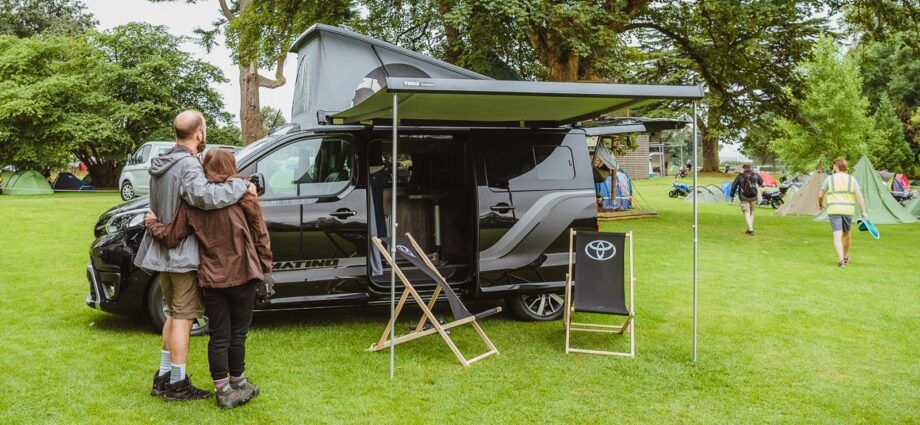
Recent world events have made us reevaluate foreign travel and look towards staying within our borders for our breaks. Could the Toyota Proace camper be the perfect solution for this year’s stay-at-home summer? Stuart Bird finds out…
Overseas travel is still difficult, and camping is experiencing something of a boom, with demand growing, but the British weather can still put a lot of people off. A camper van is an obvious answer, offering comfort and warmth while allowing you to venture to more remote parts of the country. Toyota has decided to join the burgeoning market with its Proace Matino 2 camper van, converted by Wellhouse.
What started as a humble Proace van, ideally suited to a life of lugging parcels around for your local Hermes delivery driver, has been kitted out by Wellhouse to be a home-from-home. It’s being sold as a four-berth with two double beds, a sink, twin gas hobs and a fridge. Ok, a home-from-home might be a stretch, but it’s all that you’ll need for an extended break away.
Toyota Proace Matino 2 Camper: Style and Function
Open the sliding door, and you’re greeted by a conventional side-mounted interior. Stylish Italian units ooze more razzmatazz than you’d expect from a Toyota; there’s a dark wood-effect grain pattern, brushed aluminium detailing, and mood lighting lifting the ambience.
An essential element of any camper van is how easily it converts from van to temporary home upon arrival. Simple tasks like turning on the gas or filling up the water tank can be laborious, but the Proace conversion makes most of that easy. The essential gas bottle is stored in an easily accessible cupboard at the rear, while the 20-litre water tank is filled by the sliding side door.
When you switch on the electrics and activate the infotainment screen in the back, you get your first glance of the batteries’ power reserves and how much energy the roof-mounted solar panels are providing. The control panel also gives access to the many lighting setups around the living area and under the awning, which is a nice touch.

A 165cm-long load area is ideal for transporting bikes and other holiday equipment and keeping it safe and secure on location, too. I’d seriously recommend laying down a rug over the four floor runners when camping though; at one point my small toe almost got caught in one.
The van itself is efficient and comfortable, with a frugal 2.0-litre diesel engine and surprisingly compliant suspension. The eight-speed automatic gearbox chooses the gears well, and as long as you aren’t in any hurry, it will carry out its touring function with little fuss. Get enthusiastic, and it’ll grip the road well, resisting body roll nicely, but you’re always aware that this isn’t a vehicle to push limits in.
Toyota Proace Matino 2 Camper: Living Room
The Proace is a decent-sized van, so the living area is quite commodious. Both front seats swivel around, turning the interior into a comfortable four-seater lounge. The table provides an extra surface for food preparation or entertaining. It’s lightweight and free-standing, which allows you to use it anywhere you want, inside or out—a simple feature that is overlooked in more expensive vans.
There are cupboards and cubby holes fitted along the side unit. There is no specific placement list that you have to follow, so it would be up to you to decide where you want stuff — stack your plates where you like and leave more room for the drinks — although bear in mind that these are not the largest of spaces. You soon learn to adapt to its ways, making it a liveable space.
The rear seat, however, does have a few concerns for me. The backrest is too tall, effectively blocking rear vision through the window. Despite standard parking sensors, a rearview camera would alleviate this issue completely. Unfortunately, there is no option from Toyota for this.


Toyota Proace Matino 2 Camper: Kitchen Capers
A combined sink and two-burner gas hob are fitted under two glass covers, allowing for an uncluttered work surface area when not in use. The hob is on the small side, so a large frying pan won’t safely fit over it — it would be wise to carry suitable cooking equipment instead of taking what you have from home.
Even with the hob in use, the sink can be covered with one of the glass panels, leaving that and some spare worktop to the side available for your food prep.
There’s a large window in front of the kitchen, letting you take in any views while you get ready for dinner. It might not be quite as connected with nature as an outdoor grill, but you’ll stay warm and dry — something that’s not often guaranteed in the UK.

Toyota Proace Matino 2 Camper: Sleeping
Nighttime is not without its problems, and those come mostly from the camper’s size — or rather, the lack of it.
There are two beds, one in the pop-up roof and one made by folding the rear seats down. However, the bed in the roof is just too small for adults, which is a problem as the lower bed, while longer, is narrower. At least that ‘rock-n-roll’ bed is easy to convert from sofa to bed and back to a sofa again.
When pulled out, it takes up almost all of the floor space, making it impossible to open most of the cupboards. Fitted to runners on the floor, you can at least slide the bed towards an open rear door, allowing you to access the fridge for a late-night snack. Open the huge tailgate, and you can also take in the sunrise with a cup of alfresco coffee.
Toyota Proace Matino 2 Camper: Verdict
The main reason for buying a camper van is being able to leave everything behind, escape from the stresses or mundanity of daily life and disconnect from the demands of our busy lives. For that, the Toyota Proace Matino 2 fulfils its brief.

There are a few gripes with the Wellhouse conversion from a van to a camper, though. Build quality issues are disappointing, with spray glue being evident on a few surfaces around the rear, and some fuses hanging underneath two drawers despite there being a well-appointed fuse board in the rear.
Some thought needs to be given to a few of the sharp edges around the units, particularly the one next to the driver’s head. It’s just too close for comfort — I know; I caught my head on it.
Despite being described as a four-berth camper, there’s no reasonable way of making this happen. It’s just too small inside to accommodate four with any of their luggage, so think of it as a two-person touring or day van.
Take that mindset, and it will absolutely win you over. Its diminutive size then becomes a positive, making the vehicle a cinch to drive. The van is easy to drive, remarkably comfortable, pleasingly frugal, and surprisingly sprightly, so there’s no reason why you can’t use it any time you’re not heading off to a campsite. Pack everything away, and it even makes a good fist of being a proper van, so running to the recycling centre won’t cause any concern.
And, at £52,000, it’s priced below some of its more obvious rivals, such as the Volkswagen California or Ford Transit Custom Nugget and gives away little to either. The forthcoming Volkswagen Caddy California will offer a bargain alternative, though, albeit a more compact one.
This leaves the Toyota model in the centre, offering better value than its rivals while offering the backup of a 10-year warranty package. For anyone other than a couple in a committed relationship, it’s probably a bit too tight a squeeze, but it strikes a fine, if flawed, balance between luxury, equipment, refinement, and economy.

- A Motorhome from Home: Toyota Proace Matino 2 Camper - 5 January 2022