

Littlemill Testament is a rare and exclusive whisky expression limited to just 250 decanters, each of which comes with a unique piece of Scotch Whisky history.
There has been much debate about which was the first licensed distillery, an accolade that does more than give bragging rights to the owners. Recent research has shown that this accolade goes to Littlemill , making it a vital part of the history of whisky production in Scotland.
Littlemill Distillery: Ancient History
Brewing was taking place at Auchentorlie Estate — the home of Littlemill Distilleries — as early as the 15th century. In those early days, the production was beer rather than whisky, but the brewery is thought to have regularly supplied places locally, such as Paisley Abbey.
In 1750, the estate was purchased by Archibald Buchanan. Archibald and his brother George had bigger ambitions, and in 1772, having installed a government excise agent on-site in accordance with the law, they were issued the first commercial license to retail ale, beer and other excisable liquor — and so Littlemill’s whisky journey began.
After Buchanan’s death, the distillery was leased to John Clarke until 1817, when it was sold to Matthew Clark and Co, wine and spirit brokers from London. Littlemill made history again in 1823 when Mrs Jane McGregor became one of the first licensed female distillers in the world.
By the 1920s, the industry was under pressure from the economic depression, with many distilleries falling silent. This was the fate of Littlemill in 1929 until American entrepreneur and chemist Duncan Thomas took ownership two years later. His scientific background made Thomas an innovative thinker and inspired him to introduce changes to Littlemill that are still in operation in the industry today.
The first change Thomas made was to install two hybrid stills, replacing the traditional swan neck stills. This meant that, rather than the more time-consuming triple distillation method, Littlemill could double distil the spirit while still retaining the recognisable lowland whisky flavours.
This new method also meant that Littlemill was able to adjust the stills during the distillation process, allowing the production of three distinct styles of spirit – light, full-bodied and heavily peated. This gave the distillery a distinct advantage after World War II when the market for blended whisky boomed. Malt distillers were under pressure to produce single malts for the blends, and Littlemill could not only produce more than one whisky type, but they could also do it more quickly, too.
In 1964, Duncan Thomas partnered with the American company Barton Browns to open another distillery — Loch Lomond — where production began in 1965, using the same hybrid stills and double distilling process.
Once again, economic instability adversely impacted the distillery industry, and between 1983 and 1985, 40 Scottish distilleries closed down. Littlemill and Loch Lomond were both casualties and ceased production in 1984.
But this was not to be the end of the journey. After lying dormant for several years, Loch Lomond resumed production in 1987, followed in 1989 by Littlemill. Sadly, however, Littlemill operated for only five years before it closed its doors for the final time, with a fire in 2004 destroying what little was left standing. The remaining barrels of spirits are now stored at the Loch Lomond distillery, which is still operating at Alexandria, just a few miles from the Auchentorlie Estate.
Littlemill Distillery: Today’s Testament
These remaining barrels, the final legacy of Littlemill, have, since 2007, been under the care of Loch Lomond’s master distiller Michael Henry. Under his watchful eye, the definitive Testament expression from this unique cellar has been released.
“I’m very proud of the result, which perfectly captures Littlemill’s signature style,” explained Henry. “It is an honour to have been able to play my part as current custodian of the remaining casks from the original Littlemill Distillery and release Littlemill Testament, which pays homage to this whisky’s unrivalled history.”
The liquid for this release has been taken from a single distillation date, 4th October 1976. It was re-casked into American oak hogsheads in 1966 before transferring into first-fill oloroso sherry hogsheads for a final four-month maturation before bottling.
Littlemill Distillery: Testament Tasting
Sitting down with master distiller Henry, we sampled a small dram of the Testament expression. Henry’s detailed knowledge, especially regarding precisely which barrels had been selected and the process involved in reaching the point of being happy with Testament, was interesting and added depth and colour to the tasting.
But, as with all new expressions, all the history in the world can’t save a bad blend. Fortunately, there’s no such risk here. The Littlemill Testament starts well, with a crisp nose, with all sorts of apple notes, some zesty citrus tones, and a floral note above it all that brings it together.
Taking a sip, the flavour is positively vibrant. There’s a lot happening, with pineapple and peach giving way to lime undertones. The oak barrels give the drink a huge kick of sweetness and vanilla, with some floral notes tucked away behind the bang.
The finish lingers but isn’t too long, with the sweet notes giving way to equally sweet fruit flavours – think watermelon, more pineapple, and perhaps even passion fruit. Then, as it fades, it switches everything again, giving way to a final hit of cinnamon and nutmeg.
Littlemill Distillery: Lasting Legacy
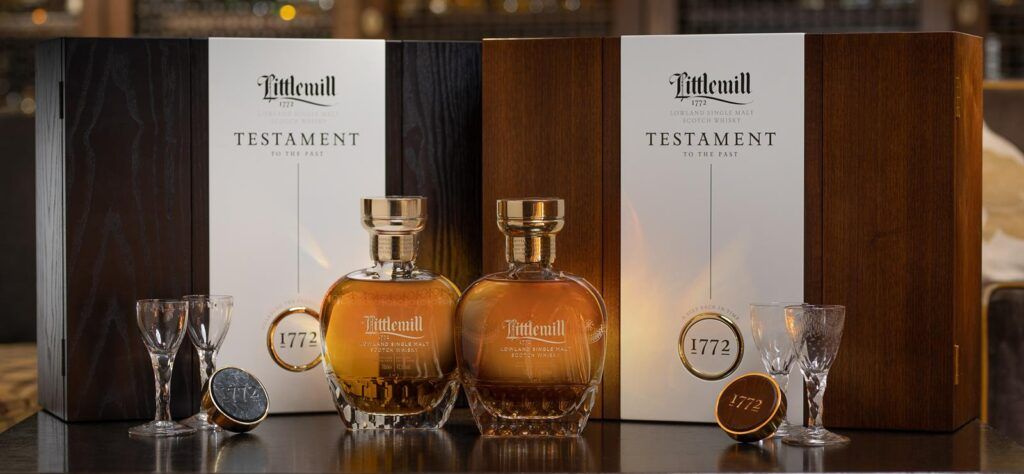
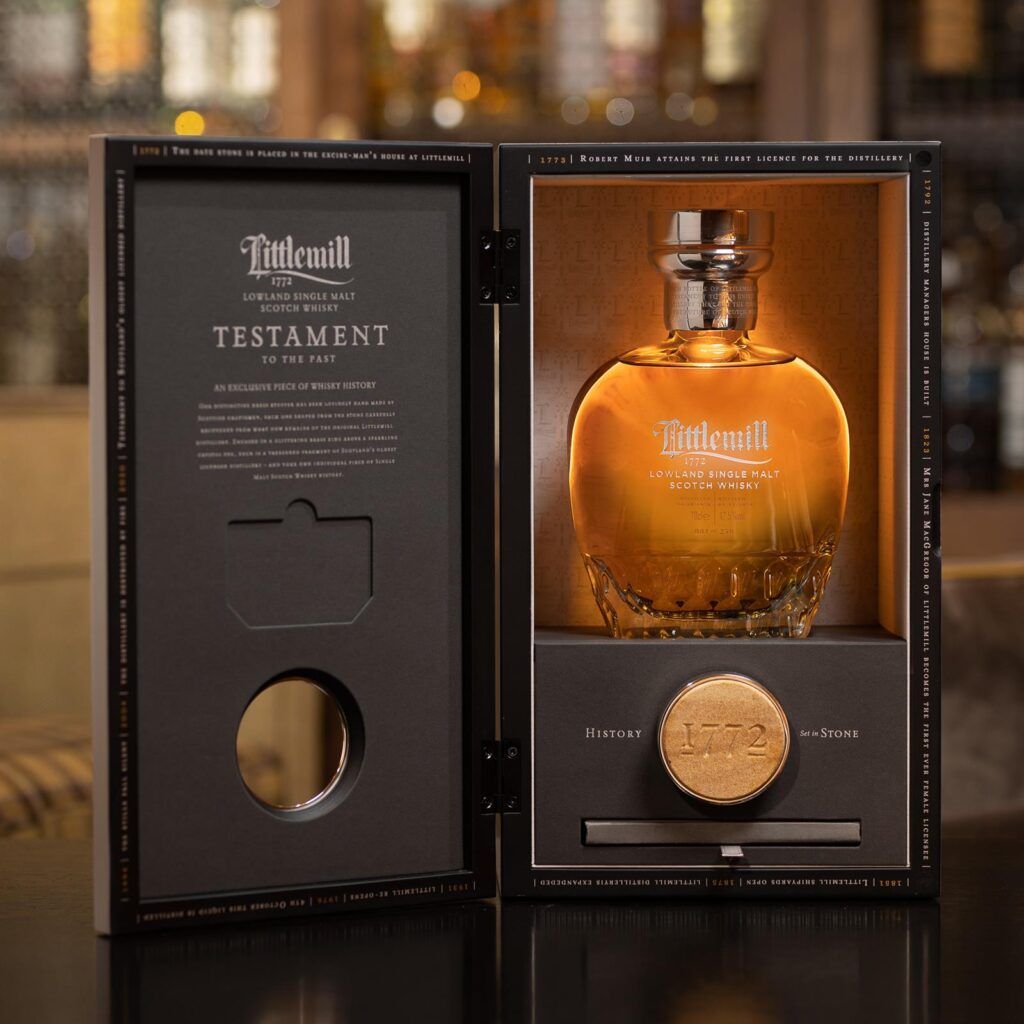
Fitting for such a rare and important single malt, exceptional attention to detail has been given to the presentation of the whisky, which comprises a total of just 250 decanters. Each is crafted in hand-blown Glencairn crystal, which has been facet cut at the base, mirroring the style of glass cutting during the Georgian period, and housed in a bespoke handmade cabinet.
Each cabinet comes complete with a dress stopper made from the sandstone taken from the remains of the Littlemill distillery, giving the buyer a unique piece of Scotch whisky history.
Finally, for collectors who wish to leave the decanter untouched, each comes with a unique code allowing the owner to claim a couple of 50ml measures (separately, if required) of the precious liquid; this will enable collectors to protect their investment, keeping both the bottle and the presentation intact.
Littlemill also revealed that it’s producing four unique decanters with some spectacular details. Each of the four decanters is accompanied by a pair of specially sourced Georgian glasses, dating back to the 18th century, with the facet cut on the stems of each pair, and engraving around the bowl, replicated on each decanter.

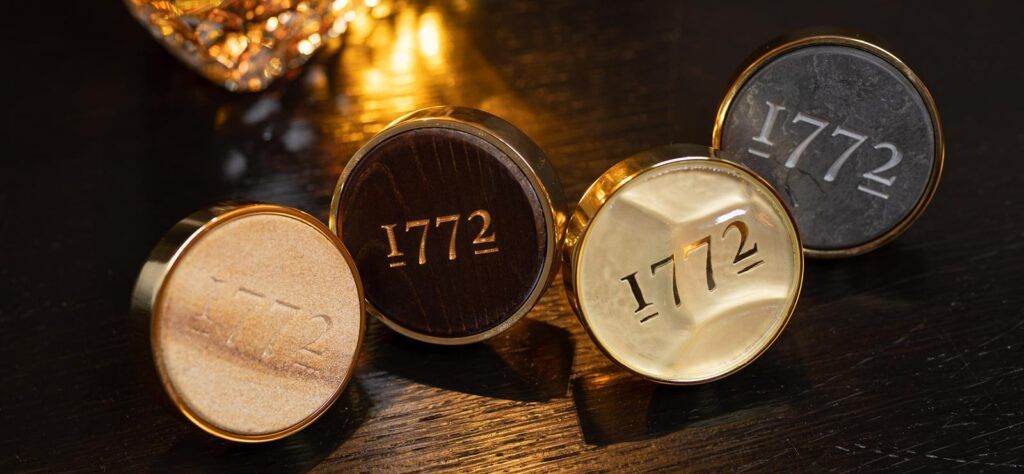
The dress stoppers within the limited editions are unique, each crafted from one of the materials salvaged from the original distillery building, giving collectors a chance to become custodians of a rare piece of Scotch whisky history. The first is completed with slate sourced from the roof of the distillery manager’s house, the second with glass from the window, the third with wood from the floor, and the final stopper with stone from the building itself.
Each special decanter contains a wooden disc cut from a stave from the Littlemill barrel, which conceals a unique code that can be used to request two 5cl samples of the Littlemill Testament liquid.
“Littlemill Testament is a fitting tribute to the rich heritage that this exceptional whisky enjoys, allowing whisky lovers to own a piece of history,” commented Colin Matthews, CEO of Loch Lomond Group. “In addition to our Limited Edition release, it is a pleasure to also reveal our four unique Littlemill Testament decanters, which offer the ultimate tribute to Littlemill’s fascinating past.”
The first of the four unique decanters was auctioned in China in January, reaching a price of £19,000, with the remaining three going to auction later this year.
What: Littlemill Testament Limited Edition
Where: Specialist retailers, including The Whisky Shop
How much: £8,000

- Havana Club Golden Mojito: Should you mess with a classic? - 10 August 2026
- Sipping summer spritz with a Cotswolds Distillery twist - 4 August 2026
- Blue Turaco coffee: A cuppa with a conscience - 22 July 2026